Signed by then Director of National Intelligence, James E. Clapper, in June 2017, SEAD-4 is the common regulatory rubric for all Executive branch elements with Security programs evaluating national security eligibility. There are many Security programs: some free-standing, some using the services of the Defense Counterintelligence & Security Agency (DCSA). The rules will vary between the different employers, but all adhere to SEAD 4.
There are thirteen (13) guidelines applied within SEAD-4. The guidelines allow security investigators and adjudicators to identify and resolve “security concerns.” Once the security concern is declared, the monkey is on the applicant or holder’s back. It is the individual’s task to clear their name—to push the monkey off.
SEAD-4 is the product of decades of U.S. security history: threats intercepted and threats not intercepted in time. When you are reviewed for eligibility for access to classified information, that concrete history is what informs how adjudicators view the facts in your file. And when you apply for a security clearance, you agree to conform your professional life—and to no small extent your personal and family life—to this security system.
The Development of the Modern Federal Personnel Security System
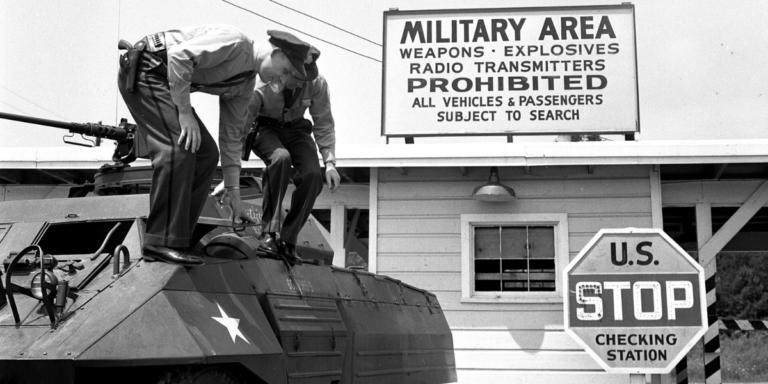
SEAD-4’s origins lie with Executive Order (EO) 10450 (1953), promulgated during the Cold War to combat Federal employees spying for the Soviet Union. Three concerns dominated these initial standards: loyalty, suitability for employment, and maintaining the security of classified information. All three standards appear in later revisions.
1941 – 1953: Vetting the Federal Workforce
Security concerns during World War II touched off the modern efforts to regulate federal employees through security regulations. Executive Order 8781 (1941) required federal employee fingerprinting. The Federal Bureau of Investigation (FBI) established a criminal background check system. War Service Regulation II (1942) applied a relatively low legal bar when denying federal employment to applicants or employees on the basis of loyalty: a “reasonable doubt” standard.
Learning from security concerns during the Manhattan Project, the Atomic Energy Act (1946) mandated a security program for the Atomic Energy Commission. The FBI was again tasked: this time to investigate applicants’ character, associations, and loyalty. Executive Order 9835 (1947) then established a Federal Employee Loyalty Program with Loyalty Review Boards. The Civil Service Commission (CSC) was then charged with conducting investigations for federal “competitive service” positions. This was the beginning of what is now called a “Public Trust” review for employment suitability.
The service secretaries then entered into a joint agreement (1948) as the Defense Department unified the military security program and implemented standards and procedures similar to those put into effect for civilians under EO 9835.
Executive Order 10450 (1953) superseded EO 9835. It required investigations of federal employees to determine reliability, trustworthiness, good conduct and character, and loyalty. One now sees the current standards drafted into the regulations. EO 10450 required that any individuals’ employment be “clearly consistent with the interest of national security.” Now one sees a full-field investigation applied to sensitive positions and a de minimus National Agency Check with Inquiries (NACI) for less sensitive positions.
1954 – 1965: Postwar Security Modernization
In 1954, Congress amended the Atomic Energy Act to authorize the Atomic Energy Commission (AEC) to create its own safeguards and security programs. (The Energy Department and the Nuclear Regulatory Commission (NRC) did not exist until 1977 and 1974 respectively.) This step was an important milestone, creating a “Restricted Data” protection program separate from national security clearances.
In 1956, DoD Directive 5210.9 copied the same loyalty standard for the military as had already been required of civilian employees. Executive Order 10865 (1960) then promulgated standards for federal contractor employees’ access. In 1965, a policy distinction was created dividing “sensitive” positions into “critical-sensitive” and “non-critical sensitive” positions. The requirement for full-field investigations for non-critical sensitive positions was deleted.
Ready to book your consultation? Click below to pay our consultation fee and book your meeting with an attorney today!
Consolidation and Standardization Amidst Globalization
The Defense Investigative Service (DIS), created in 1972, consolidated DoD Personnel Security Investigations (PSI) previously conducted separately by the U.S. Army, Navy and Air Force. It also produced one concentrated database for cyber exploitation: an issue which would emerge as a criterial counterintelligence threat a quarter-century later. DIS’s mission would molt over the years, moving to OPM, then to DCSA.
In December 1979, DoD promulgated DoD Directive 5200.2, Personnel Security Program, and its implementing regulation, DoD Directive 5200.2-R. The first DoD Adjudicative Guidelines were attached to DoD Directive 5200.2-R in March 1981. Although the regulation itself defined seventeen (17) standards, only nine (9) guidelines were published in this first version. This historic regulation harmonized personnel security policy in the Department.
The Director, CIA exercised his own prerogative in 1980 by issuing Security standards through the Director of Central Intelligence (DCI) for Sensitive Compartmented Information (SCI) Access. The first adjudicative guidelines specifically for SCI version were attached to a DCI Directive (DCID) 1/14 revision, March 1980. After 9/11, the CIA lost this function to the Office of the Director, National Intelligence: the ability to dictate standards to the rest of the Executive branch. At that time, Langley’s authority over personnel security standards stemmed from Director of Central Intelligence Directive (DCID)1/14.
Up into the 2010s, the DNI would continue to regard its security role as limited to the protection of SCI. This changed once the Snowden-era leaks necessitated a heightened regulatory focus on “Insider Threats” within the ranks of Federal employees, cadre, contractors and service members.
The 1981 Defense Adjudicative Guidelines focused on ‘consistency’ as a value across the Department’s Security decision-making. The first uniform Adjudicative Guidelines for the Executive branch were issued in EO 12968 (1995). The uniform Guidelines applied to both collateral and SCI access. Another reform was implemented in January 1993 when President Clinton issued EO 12829, creating the National Industrial Security Program (NISP). This moved industrial contractor oversight to a single national program negotiated between the “Heavies,” the four cognizant security agencies: DoD, CIA, the Department of Energy (DoE), and the Nuclear Regulatory Commission (NRC).
The Defense Adjudicative Guidelines were revised in 2005. Updates in 2005 included standards for information and communications technology, globalization, and global migration. As globalization accelerated in the Aughts, the uniform Adjudicative Guidelines saw renewed focus by the Office of the Director of National Intelligence (ODNI), with a review effort in 2009.
You can contact us 24 hours a day, 7 days a week via phone at 8885294543, by e-mail at info@tullylegal.com or by clicking the button below:
History Informs Security Clearance Adjudications
The background presented supra is not mere ‘context’; it is the narrative a Security adjudicator brings to the review of an applicant’s or holder’s presentation of facts in furtherance or defense of a security clearance. Too many have strayed down the path of thinking Federal employment is a ‘right.’ Rights-talk is fine for aspects of Federal employment, such as Equal Employment Opportunity, but the Security process is effectively organized as ‘privilege.’ Offend the ‘order’ described by the background to ones’ experience, and one will find themselves outside the circle of trust.
The Federal personnel security system has been studied, and reformed, studied, and reformed, studied, and reformed, in a call-and-answer pattern for almost a century now. Founded during the Second Reagan Administration in 1986, the Defense Personnel Security Research Center (PERSEREC) has conducted many of these studies. The October 2002 PERSEREC study analyzed data on the reasons for revoking security clearances. The reasons referred to one or more of the thirteen (13) Adjudicative Guidelines. Remember, the Republic’s counterintelligence experience is distilled into case studies, which then define the Adjudicative Guidelines, which then ‘map’ to one or more questions on the SF-86/PVQ: effectuation of the personnel security system is a seamless whole.
The PERSEREC data proved consistent across the set of persons from whom clearances had been revoked: service members, civilian employees, and civilian contractors. Revocations frequently cited multiple issues. The most frequent were personal conduct (which includes lying, lack of cooperation with security procedures, and refusal to comply with rules), followed by alcohol, drug use, criminal conduct, and financial problems. Less frequently cited were sexual conduct, falsification of personal information, and psychological conditions. Issues pertaining to allegiance and the foreign influence or foreign preference are rare overall.
The overarching system is huge: over 4 million clearances, a little over 2 million at Top Secret (TS) and above, and about 300,000 under review at any one time. So even if the Guideline triggered is a minority report in the grand scheme of things, it is still significant to the holder or applicant.
Dan Meyer, Esq. is a Partner at Tully Rinckey PLLC’s Washington, D.C. office and has dedicated more than 25 years of service to the field of Federal Employment and National Security law as both a practicing attorney and federal investigator and senior executive. He is a lead in advocating for service members, Federal civilian employees, and contractors as they fight to retain their credentialing, suitability and security clearances.
Tully Rinckey attorneys understand that issues involving security clearances can be challenging, and they will handle your matter with the attention and tact it deserves. If you have additional questions, our team of dedicated security clearance attorneys is available to assist you today. Please call 8885294543, or schedule a consultation online.