If my commander issues me an unlawful order, do I have to obey it?
The short answer is no; you do not have to obey an unlawful order from your commander. The Law of War Manual clearly states that it is the duty of service members to “refuse to comply with clearly illegal orders to commit violations of the law of war.” However, to quote the Manual for Courts-Martial, an order “is disobeyed at the peril of the subordinate.”
The Uniformed Code of Military Justice (UCMJ) criminalizes willfully disobeying a superior commissioned officer. Failure to comply with a lawful order could result in prosecution (UCMJ Article 90 in this case; or Article 91, non-commissioned officer; or Article 92, failure to obey without proof of willfulness). But failure to disobey an illegal order could result in criminal liability.
This leaves service members with a very heavy question: How should a service member decide which orders are illegal and must be disobeyed? It is not a political or ethical question, but a legal one. Here are some common points of misunderstanding on the duty to disobey unlawful orders: who determines an order’s lawfulness, the legal obligations of service members, and when following an unlawful order may result in criminal liability.
Military judges determine the lawfulness of an order
Commanders and judge advocates general are not the ones who decide if an order is ultimately lawful. A military judge (or panel) determines an order’s lawfulness. If a service member is court-martialed under Article 90 for refusing to follow an allegedly unlawful order, a judge would decide the lawfulness question after a hearing. Should the judge find that the order was unlawful, the service member may be exonerated. But if the order is found lawful, conviction is likely.
This would look different in the alternative scenario, where a service member is criminally charged for committing a crime pursuant to an unlawful order. The judge would be determining whether the service member is criminally liable for following the unlawful order. Liability is related to but distinct from the lawfulness question. In other words, it is possible for a service member to carry out an unlawful order and not be found criminally liable for doing so.
Orders are presumed to be lawful
Service members do have a duty to comply with lawful orders, as well as a duty to disobey manifestly unlawful orders. These duties are not evenly weighted, however. When a superior commissioned officer orders a subordinate to engage in a military duty or act, the presumption is that the order is lawful. This is the inference of lawfulness.
There are limits to the inference of lawfulness: it does not apply to a manifestly illegal order.
Following an unlawful order does not necessarily equal criminal liability in all cases.
Be assured that military judges don’t expect all service members to be legal experts. Military law accommodates the practical necessity of obedience. So, while military judges decide the legal fact of an order’s lawfulness, they also consider whether the situation triggered the service member’s duty to disobey it. This involves a two-part test…
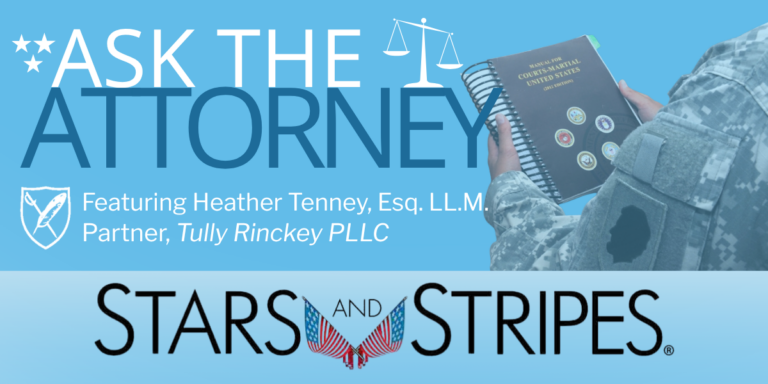
READ THE FULL ARTICLE IN STARS AND STRIPES
The law firm of Tully Rinckey represents service members across all branches of the armed forces. To discuss a potential case, please call 8885294543 to schedule a consultation, or schedule a consultation online.
Heather Tenney, Esq., LL.M. is a Partner in Tully Rinckey PLLC’s military law, federal employment, and national security law practice groups. She currently serves as the primary attorney for consultation in these areas. Heather brought her skills as an advocate and negotiator to Tully Rinckey after honorably serving with the US Army’s JAG Corps, and the results speak for themselves. At the firm, she focuses on military law; federal employment, EEO and discrimination litigation; disciplinary investigation and MSPB litigation, disability retirement, and national security clearance representation. Heather’s representation in national security and security clearance cases range from high-level military officers to covert operation officers of the CIA, NRO, FBI, DIA and a range of other intelligence agencies. Heather currently serves as Treasurer for the National Security Lawyers Association (NSLA).
This article is for informational purposes only. Its content is not intended to constitute endorsement or legal advice, nor does it establish a client-lawyer relationship with Tully Rinckey PLLC or any of its affiliates.
Ready to book your consultation? Click below to pay our consultation fee and book your meeting with an attorney today!