Military service members are held to a high standard of conduct and face restrictions on their freedom of expression that most civilians do not. For example, it is prohibited for the military to show support for one political candidate or party over another. This is partisan political activity, and engaging in prohibited partisan political activity may result in serious consequences for service members, including administrative action and punishment under the UCMJ. However, distinguishing between prohibited partisan political activity and permitted nonpartisan political activity can be difficult in some circumstances.
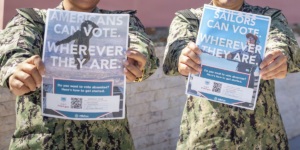
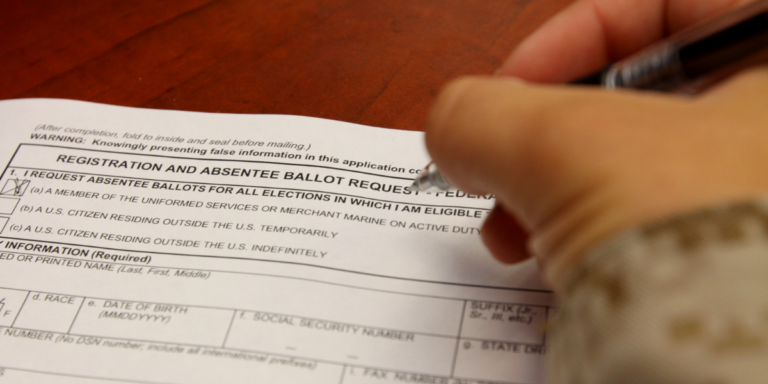
Service members can and should vote in elections, and may also encourage others to exercise their right to vote. It is encouraging or pressuring others to vote a particular way, or implying that the military supports a particular candidate or party that is prohibited.
Laws and Regulations Governing Military Political Activity
Federal law (U.S.C. Title 18 § 592) prohibits directing troops to polling locations. This law is designed to protect Americans from coercion at the ballot box, however, not to impede service members’ ability to vote. Both U.S.C. Title 18 Sections 592 (troops at the polls) and 593 (interference by armed forces) specify that they do not prohibit military from exercising their own right to vote.
DoD Directive 1344.10 (DoDD 1344.10) prohibits partisan political activity by service members. Privately casting one’s vote is not in and of itself prohibited partisan political activity. Service members are permitted to vote in uniform. However, claims like, “I voted for Candidate X, and so should you,” or “If you support Candidate X, you aren’t a real soldier” cross the line into prohibited partisan political activity.
Select political activities are permitted, but not while in uniform or utilizing Government property, facilities, or devices. An individual service member’s political activity should never give the impression that their view represents the views of their component, Department, or military generally. When a service member wears the uniform, they are making their connection to the military very clear. It is critical that service members remain cognizant of their behavior whenever wearing the uniform, or engaging in a context that suggests their military affiliation.
What Is Partisan Political Activity?
Military service members are prohibited from partisan political activity, not any and all political activity. Partisan political activity is aimed at the success or failure of a particular political party, partisan group, or candidate.
Political issues like taxation, gun control, or AI regulation are in and of themselves nonpartisan. However, this distinction becomes more challenging when an issue falls on clear party lines. It may be possible to guess with reasonable certainty how a particular soldier may vote based on their stance on certain key issues. What makes it partisan and prohibited political activity is (1) the connection to the party or candidate, and (2) it is directed toward the success or failure of a particular party or candidate.
Ready to book your consultation? Click below to pay our consultation fee and book your meeting with an attorney today!
Examples of Nonpartisan, Permitted Political Activity
Example 1: “Gun rights are an important issue for me. I hunt, grew up in a family of hunters, and I trust my neighbors to handle guns responsibly.”
Example 2: A mug that says PROUD GUN OWNER.
Example 3: A keychain that says PRO CHOICE.
Example 4: “Don’t forget to vote.”
Example 5: A sign that says OBAMA 2012.
Note for example 5 that this is partisan, but because it is not directed toward the success or failure of a current candidate, it is permitted. If Obama were a current candidate, this would be prohibited.
It may be possible to infer a partisan preference from the above examples, but it is not certain. It is perfectly possible to follow party lines on one issue but not another. The above are not strictly prohibited under DoDD 1344.10, but Command may still deem them prejudicial to good order and discipline.
Examples of Prohibited Partisan Political Activity
Example 1: “Gun rights are an important issue for me. I hunt, grew up in a family of hunters, and I trust my neighbors to handle guns responsibly—way more than I’d trust any Democrat trying to take those guns away.”
Example 2: “Gun rights are an important issue for me. I hunt, grew up in a family of hunters, and I trust my neighbors to handle guns responsibly. That’s why I’m voting for Jill B. A. Candidate. Because I actually care about my community.”
Example 3: “You should vote however you want. But if you care about gun rights and keeping your community safe, you should vote for Jill B. A. Candidate.”
Example 4: “As a U.S. Marine, I don’t see how anybody in the military could support John P. Artisan for office.”
A Final Caution
One service member’s political involvement should never be mistaken for official military or government involvement. The distinction between permitted nonpartisan political activity versus prohibited partisan political activity is not always obvious. For instance, not all groups, clubs, or committees affiliated with a partisan political party, group, or candidate make their ties clear by name alone. Moms for Liberty is associated with the Republican Party, for example, while EMILY’s List is associated with the Democratic Party. Advocating for either of these groups may constitute partisan political activity.
Finally, just because a regulation does not specifically prohibit a very particular activity does not mean that activity will not result in discipline. DoD Directive 1344.10 makes punishable any activities that are “contrary to the spirit and intent” of the directive or which “may be reasonably viewed as directly or indirectly associating” a partisan political activity with the U.S. military. When the lines between prohibited and permitted activity are unclear, it is generally advised to err on the side of caution and refrain from the activity.
The military law attorneys at Tully Rinckey PLLC served long before they became lawyers. They know the military, they know the law, and they are ready to fight hard on your behalf. If you have additional questions about your rights and responsibilities as a service member, our team of dedicated military law attorneys is available to assist you today. Please call 8885294543 to schedule a consultation, or schedule a consultation online.
Heather Tenney, Esq., LL.M. is a Partner in Tully Rinckey PLLC’s military law, federal employment, and national security law practice groups. She currently serves as the primary attorney for consultation in these areas. Heather brought her skills as an advocate and negotiator to Tully Rinckey after honorably serving with the US Army’s JAG Corps, and the results speak for themselves. At the firm, she focuses on military law; federal employment, EEO and discrimination litigation; disciplinary investigation and MSPB litigation, disability retirement, and national security clearance representation. Heather’s representation in national security and security clearance cases range from high-level military officers to covert operation officers of the CIA, NRO, FBI, DIA and a range of other intelligence agencies. Heather currently serves as Treasurer for the National Security Lawyers Association (NSLA).