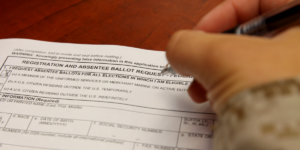
Military service members are U.S. citizens, and thus free to engage in the political process. At the same time, there are limitations on service members’ political activity, particularly when elections are involved. The consequences for violating the directive against partisan political activity (DoD Directive 1344.10) can be severe, ranging from counseling to court-martial. Service members must be mindful of the restrictions on their activity to ensure compliance with service regulations and federal law.
The Hatch Act and the Military
The Hatch Act (5 U.S.C. §§ 7321–7326) regulates the political activities and expression of federal employees, including military civilian personnel. Members of the uniformed services are specifically excluded from the Hatch Act’s definition of “federal employee.”
Federal employees are prohibited from using their official positions to promote a particular party or candidate. This includes displaying political posters or banners, soliciting political donations, or using government property, facilities, or time to engage in political activity. In addition to maintaining fairness and integrity in elections and government operations generally, the Hatch Act shields federal employees from political pressure at the workplace. For example, a manager’s overt support for one political candidate may place undue pressure on subordinates to vote a certain way, intentionally or not.
Restrictions on Military Political Activity
The Hatch Act does not apply to military service members, but they too are restricted from engaging in certain political activity. DoD Directive 1344.10 is the closest analogue to the Hatch Act for the military. Federal law also criminalizes political interference by the military (U.S.C. Title 18 §§ 592, 593). For most service members, however, DoD Directive 1344.10, as well as any component-specific regulations, are most relevant.
Penalties for Violating Prohibitions on Partisan Political Activity
DoD Directive 1344.10 contains punitive provisions (paras. 4.1 – 4.5). Violations may result in administrative punishment or criminal punishment/court-martial. Violating DoD Directive 1344.10 is punishable under UCMJ Article 92 (10 U.S.C. § 892) for failure to obey a lawful general order or regulation. Consequences may include dishonorable discharge, forfeiture of pay and allowances, and up to two years’ confinement.
Partisan political activity involving contempt toward officials may further result in charges under Article 88, Contempt toward officials (10 U.S.C. § 888) in the case of commissioned officers, or Article 134, General article (10 U.S.C. §934) for others.
You can contact us 24 hours a day, 7 days a week via phone at 8885294543, by e-mail at info@tullylegal.com or by clicking the button below:
Why Is Partisan Political Activity Limited for Military?
Restrictions on partisan political activity for military members are designed to protect the American democratic process in several ways, including for service members themselves.
Norm of Nonpartisan Military
The nonpartisan nature of the U.S. military is a long established norm; it is critical to ensuring its trustworthiness in the eyes of the American people. The military takes its commitment to serving and defending all Americans, regardless of party affiliation, very seriously. Service members are held to a high standard when their behavior may be seen as reflective of the U.S. military. This heightened standard is especially important in partisan political matters because it is critical that the U.S. military not be perceived as favoring one political candidate or party over another. Regulations like DoDD 1344.10 are designed to ensure no service members’ personal political views be misconstrued as representative of the U.S. military as a whole.
Interference in Elections
The U.S. military commitment against using military force to compel or coerce the American people dates to its earliest days under President George Washington. Democracy depends upon the American people’s ability to choose their own representatives and leaders without fear of reprisal from the military. Federal law separately criminalizes use of the military to interfere in elections. U.S.C. Title 18 § 592 (Troops at polls) prohibits anyone in the chain of command from directing troops to polling locations. U.S.C. Title 18 § 593 (Interference by armed forces) prohibits anyone in the armed forces from preventing others from exercising their right to vote, such as through intimidation, coercion, or force.
Protecting Military Service Members’ Political Rights
Military service members are American citizens, and encouraged to exercise their suffrage rights without fear of reprisal for how they vote. If a superior officer expresses preference for one candidate or party over another, this may pressure subordinates to vote a particular way. Even if unintended, such influence is inappropriate and prohibited by military regulations. Service members, like civilians, should be free from undue pressure when exercising their right to vote.
Complying with Regulations During Election Season
Individual service members play a key role in supporting American democracy and a nonpartisan military. While they face more restrictions on their conduct and activities than most civilians, service members are permitted and encouraged to participate in the political process. It is critical to do so within the bounds of military regulations and federal law, however, by maintaining a clear separation between one’s military membership and personally held partisan political positions.
The military law attorneys at Tully Rinckey PLLC served long before they became lawyers. They know the military, they know the law, and they are ready to fight hard on your behalf. If you have additional questions about your rights and responsibilities as a service member, our team of dedicated military law attorneys is available to assist you today. Please call 8885294543 to schedule a consultation, or schedule a consultation online.
Heather Tenney, Esq., LL.M. is a Partner in Tully Rinckey PLLC’s military law, federal employment, and national security law practice groups. She currently serves as the primary attorney for consultation in these areas. Heather brought her skills as an advocate and negotiator to Tully Rinckey after honorably serving with the US Army’s JAG Corps, and the results speak for themselves. At the firm, she focuses on military law; federal employment, EEO and discrimination litigation; disciplinary investigation and MSPB litigation, disability retirement, and national security clearance representation. Heather’s representation in national security and security clearance cases range from high-level military officers to covert operation officers of the CIA, NRO, FBI, DIA and a range of other intelligence agencies. Heather currently serves as Treasurer for the National Security Lawyers Association (NSLA).
Ready to book your consultation? Click below to pay our consultation fee and book your meeting with an attorney today!