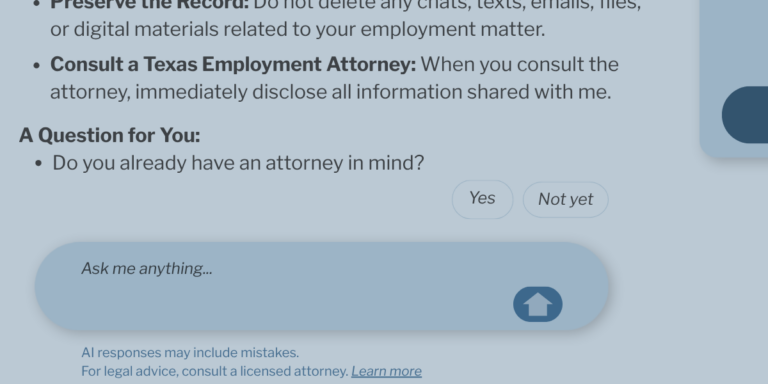
Savvy users are well aware that they should take any AI-generated legal advice with a pound of salt. For many, AI search is only a preliminary step before determining whether their situation merits contacting a law firm at all. But the risk is not only that AI-generated output may be misleading. The risk is the fact that your AI use may have serious legal consequences. As your case progresses further, the risk becomes higher. Critically, that risk is never zero.
Just one of the major concerns is that your AI use will be discoverable, in whole or in part. As a result, you may be required to provide the other side with far more information than they might have had access to otherwise.
What Is Discovery?
Discovery is the pre-trial process where both sides provide and request evidence from each other. There are no dramatic reveals in court. You cannot use evidence to make your case unless it has already been shared with the other side in discovery. Discovery is a highly regulated, multi-stage process governed by Rules of Evidence. Rules of Evidence differ between jurisdictions and courts. Ultimately, it is the judge who determines whether or not something is discoverable.
What Is Discoverable Evidence?
Your information is discoverable when it is (1) relevant and material, and (2) not protected by privilege. This can include password-protected digital items like your texts, social media activity, and emails. And in some cases, this may include information related to your AI use, such as:
- Name of the tool used (e.g., ChatGPT, Claude, Gemini)
- Discovery materials provided to AI
- Prompts
- Conversation transcripts
For the most part, if information or evidence is relevant to proving something material to the case, it is discoverable. Exceptions to this principle are few, narrowly defined, and sometimes fragile—like privilege. Common examples of privileged communications are those between spouses, a client and their attorney, and a patient and their doctor.
In Texas, discovery procedures and the scope of what is and is not discoverable are heavily regulated by the Texas Rules of Civil Procedure. When information is protected by privilege, it is not discoverable in Texas civil court (with some exceptions). One valuable form of protection is Work-Product Protection.
Work Product
Work product is material prepared in anticipation of litigation—comparable to an attorney “doing their homework” before trial. Generally, work product is protected and shielded from discovery. But how work product is applied, including the scope of its protection, differs between jurisdictions. Not all jurisdictions extend work-product protections to materials prepared by a represented party; some restrict work product to materials produced by an attorney or a pro se litigant. It is also possible to give up (“waive”) work-product protections through certain forms of disclosure.
Work Product in Texas
The standard for protectable work product differs under Texas rules (TEX. R. CIV. P. 192.5(a)(1)). In Texas civil cases, the scope of work product protections covers materials produced by the party represented, not only the attorney. This distinguishes Texas rules from the federal standard, in which client-produced materials may only be protected if directed by the attorney.
Can AI Chatbot Conversations Count as Work Product?
2026 has been a year of courts across jurisdictions wrestling with questions about AI, including whether (and under what conditions) AI use might qualify as protected work product. Rulings from another jurisdiction are not precedential; Texas courts are not obliged to follow Colorado district court rulings, for example. But the analysis may be convincing, especially as judges try to establish some level of consistency on the evidentiary issues AI poses. Though plenty of unknowns remain, certain trends have emerged in district courts to answer two key questions:
- Can an AI chatbot conversation qualify as protectable work product at all?
- Is the nature of generative AI such that AI use itself waives work-product protection?
Your AI chatbot conversations may or may not be protected as work product, in whole or in part. It depends on a number of factors, like jurisdiction and whether you are represented by an attorney or representing yourself (pro se). Even if the contents of the conversation are protected, other relevant information may still be discoverable: from simply identifying the tool used, to identifying any discovery materials shared with AI.
Ready to book your consultation? Click below to pay our consultation fee and book your meeting with an attorney today!
AI Conversations as Work Product in Texas
No official opinion has come out of Texas courts to definitively answer the matter. Though, a June 3, 2026 minute entry from a Texas Business Court (11th Division) has signaled the reasoning Texas courts are likely to adopt when considering AI. At issue here was the question of whether a represented plaintiff’s ChatGPT conversations:
1) Qualified as protectable work product at all; and,
2) Whether using ChatGPT waived any work-product protections.
The Texas Court deployed the reasoning laid out in two federal cases: Warner v. Gilbarco, Inc. (E.D. Mich. Feb. 10, 2026) and Morgan v. V2X, Inc. (March 30, 2026). This pair of federal cases concerned AI use by a pro se litigant. Because the parties were representing themselves, materials they produced in anticipation of trial qualified as protectable work product under the federal standard. The operative question was whether the nature of the AI tool itself resulted in a waiver of work-product protection.
Both Warner and Morgan held that using an AI tool like ChatGPT did not waive work product. In order to waive work-product protection, the materials must be disclosed to an adversary. In Tate, the Texas court likewise reasoned that the plaintiff’s use of ChatGPT did not automatically count as disclosure to an adversary, and so did not waive work-product protection.
Legal Risks of AI Use Remain in Texas
The Tate minute entry is not an official order, and case law surrounding AI is still developing. But Tate remains an important guide for Texas civil litigation. However, Tate did not only signal that a represented plaintiff’s ChatGPT conversations can qualify as work product. It also noted the limitations of work-product protections. Critically, the Court flagged other evidentiary concerns, like confidentiality and potential violations of protective orders.
Should a plaintiff be found in violation of a protective order after disclosing confidential information to an unauthorized third party—like ChatGPT—it could irreparably damage their case. Such violations can come with steep penalties: some could be costly to repair at best, and result in dismissal or loss at worst.
AI Use Can Work Against You in Texas
Texas rules provide a more expansive definition of work product than other jurisdictions. Even so, using AI tools to research, discuss, or analyze your legal matter can seriously harm your case. As Judge Dorfman stated, “work product protection extends only so far.”
If you have an attorney, consult them before using an AI tool for anything related to your matter. And if you have already used AI, contact your attorney before taking further action. Do not attempt to scrub your AI history or delete any chats before receiving professional legal counsel.
Ultimately, it is up to you to decide what level of risk you are willing to take on. The advice to “consult professional legal counsel” might feel trite. But when it comes to AI, where the case law is still developing and the outcomes can differ widely between situations, consulting an attorney is especially advised. Doing so may save you the additional expense of trying to contain and repair a situation after the damage is done, rather than preventing the damage in the first place.
Texas employment is subject to laws and regulations that differ significantly from those in other states. Consulting with a Texas employment lawyer can make all the difference. Tully Rinckey’s team of dedicated employment attorneys is available to assist you today. Please call 8885294543 to schedule a consultation, or schedule a consultation online.
Michael C. Fallings focuses his practice on federal sector labor and employment law, and has extensive experience litigating cases on behalf of employees at the U.S. Merit Systems Protection Board (MSPB), Equal Employment Opportunity Commission (EEOC), and in both state and federal courts. Mike also serves employees in Texas private employment matters, including claims of discrimination, whistleblower retaliation, FMLA violations, severance agreement negotiations, and breach of employment contract matters. He has received numerous awards, including the 2026 Lawdragon 500 Leading Litigators in America, LawDragon 500 the Next Generation (2024-25), Lawdragon 500 Leading Civil Rights & Plaintiff Employment Lawyers (2025), National Black Lawyers Top 40 under 40, and Super Lawyers Rising Star (2023).
This article is for informational purposes only. Its content is not intended to constitute endorsement or legal advice, nor does it establish a client-lawyer relationship with Tully Rinckey PLLC or any of its affiliates.