
The military does not provide free legal help to all service members navigating LDES or IDES. Government counsel is available for some service members—on paper—but the scope of services is limited. Availability can vary widely depending on branch, component, duty status, location, as well as current policy, office resources, current case load, and staffing. But even for those with access to free legal help, private counsel may still be the better option.
Limits of Free Government Legal Counsel in DES Process
The Department of War has directed legal resources to focus on warfighting; helping service members secure disability retirement compensation is not prioritized. The Army’s Office of Soldiers’ Counsel (OSC) has cut DES legal assistance to all but active-duty Soldiers, including Reservists and Guardsmen on active-duty orders at least 30 days. The scope of services available has also been limited to a consultation after the informal PEB decision has been issued, and representation at the formal PEB hearing. The OSC will no longer help those on the Temporary Disabled Retired List (TDRL) at all.
As of now, the Navy’s Disability Evaluation System Counsel Program and the Air Force Office of Disability Counsel (ODC) have not cut back services to the same extent as the Army. These legal services are not without problems, however.
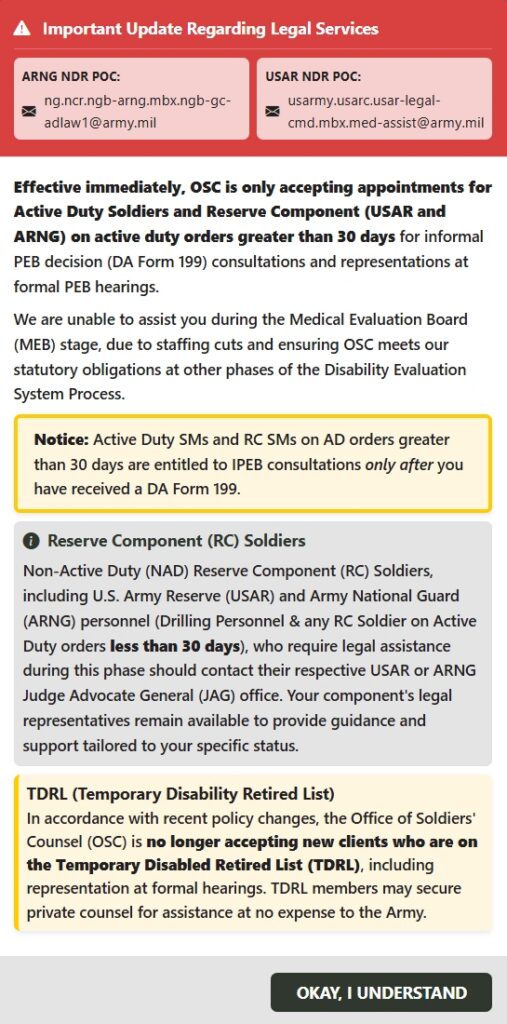
Pop-up from OSC Appointment Scheduling Portal: Important Update Regarding Legal Services [Retrieved 8/17/2026]
Service Member’s Rights in the Disability Evaluation System
It is highly difficult for a service member to receive the full benefits and compensation to which they are entitled without legal guidance. Without counsel, a service member may waive rights they did not realize they had. A PEBLO (Physical Evaluation Board Liaison Officer) is provided at the PEB phase, but they are not attorneys. Their primary task is not to ensure that a service member gets the best possible outcome. Even if they wanted to offer substantive legal advice, policy prohibits them from doing so (DoDI 1332.18 Sec. 4.5.b.(15)(a)).
A key role of legal counsel is to ensure their client’s rights are protected. While certain rights and legal safeguards have been written into statute and policy, violations occur. Service members cannot elect to begin the medical disability retirement process themselves. They must be referred to IDES/LDES. Referrals are meant to happen under specific circumstances. This is a key procedural safeguard, but it is not always observed.
Within the Disability Evaluation System (DES), there are opportunities to seek review of a decision or appeal. But doing so requires entrance to the DES in the first place. The Air Force uses a Pre-Integrated Disability Evaluation System (Pre-IDES) to evaluate service members before moving them into IDES.
In a 2025 class-action suit, service members allege that the Air Force used Pre-IDES to unlawfully bar them from the DES system. In Pre-IDES, service members do not benefit from the safeguards mandated by law. On August 7, 2026, a federal judge granted the service members’ request for summary judgment, finding the Air Force did unlawfully deprive them of their rights to access disability retirement evaluation. Watts v. Meink, No. 1:25-cv-01093 (E.D. Va. Aug. 7, 2026).
Potential Issues with Free Government Counsel
The risks of relying upon free government counsel have less to do with competence and more to do with access. Even the best military-provided attorneys face practical limitations with whom they can help, how much they can help, and when they are available.
Authorized Scope vs. Actual Availability
An individual service member may be of a component and duty status eligible for free legal DES assistance. But just because government counsel are authorized to help, does not mean they are available to help. Resources are limited, staffing has been reduced, and most offices have more cases than they would like to handle. Case overload often forces legal offices to reduce how much time they can give to any one case, limit what sort of help they provide, or lower the level of individualized attention service members receive. If an office does have attorneys trained in disability retirement, those attorneys may not have capacity to handle or advise on all DES cases. Even if you can access an attorney, you may not be accessing the attorney best equipped to support you how you need.
Sustained Consistent Involvement vs. One-Off Consults
While they may have the authority to advise you on every aspect of DES at every stage, it would be rare for an individual military attorney to have the capacity to offer counsel and representation to a single service member at every key point. For example, it is common that a service member be assigned an attorney after the IPEB for the Election of Options (EOO). A good attorney will make sure you understand the IPEB decision, your options, and the potential consequences of your choices.
Your consultation should enable you to move forward from an informed position. However, if the only legal help you receive comes after the IPEB, your options have already been limited. Any earlier mistakes, missteps, or missing information in the record must be corrected. Doing so takes considerable time and attention—a tall order for a one-or-two-hour meeting. The attorney provided for your EOO would have been far better positioned to help before your Medical Evaluation Board (MEB): helping you build a strong case, not attempting to fix the record after the fact.
If you pursue a Formal PEB (FPEB), you may be provided an attorney (who may or may not be an attorney already familiar with your case). The attorney is unlikely to meet with you until the day before your hearing. At that point, it is too late to fix a deficient record. One day is not enough time to pull missing medical reports or take witness statements.
Lack of Medical Disability Retirement Board Experience
Service members have a right to access counsel during the Disability Evaluation System (DES), but they are not legally entitled to receive free legal representation in the IDES/LDES. Individual components may offer access to attorneys as a matter of policy, not law. However, these attorneys are not necessarily equipped to handle disability retirement cases. The Disability Evaluation System is a highly specialized area of law involving multiple departments as well as medical records and procedures. Not all military lawyers are equipped to handle complex cases. A JAG inexperienced with disability boards may lack the training required to ensure you are compensated to the fullest.
Should your case intersect with another legal area, like administrative separation or divorce, your assigned government counsel may not be able to help. Ideally, you would have access to a team of military lawyers with a range of specialties and backgrounds. The legal office may have that, but whether the attorneys have the capacity to help with cases other than their own is another matter.
Internal Pressure & Military Culture
If you are assigned a government attorney, they are meant to represent you, not the military. But realize that, in general, the military’s inclination is not to grant disability retirement. Not only are resources limited, but some LOD claims may not shine a flattering light on those concerned. Reputation management is a real concern for many. Whether consciously or no, government counsel may hedge instead of clearly indicating when command acts in a “irresponsible” or “unethical” way. Others are explicitly warned against using such language in reference to the military (their employer).
Private attorneys do not face the same pressure. They are not employed by the military. They do not shy away from strong terms when necessary and appropriate. They are not concerned by the prospect of inconveniencing command by zealously advocating for their client’s interests above those of the military.
Being steeped in military culture is hardly a negative. It is important to many service members that their advocate has served—understandably so. While not all civilian attorneys practicing military law are veterans, plenty are. If this is important to you, take a look at a law firms’ Military Law pages and bios for individual attorneys in that practice area. If an attorney served, their website will often say so.
The Bottom Line: Preventative Legal Help
Government counsel can address many of the questions or issues service members may face in the disability retirement process. However, much of the legal heavy lifting takes place well before the Physical Evaluation Board (PEB) phase. Groundwork is key to success. Ensuring that the record is complete, accurate, and convincing is primary. Representation at hearings is only a small part of counsel’s possible role. A successful outcome is far more likely with an attorney’s sustained, meaningful guidance from beginning to end. But if you can only access legal counsel once, it may be far better to do so while developing the record, rather than correcting errors after the fact.
The law firm of Tully Rinckey represents service members across all branches of the armed forces in disability retirement and benefits matters. To discuss a potential case, please call 8885294543 to schedule a consultation, or schedule a consultation online.
Heather Tenney, Esq., LL.M. is a Partner in Tully Rinckey PLLC’s military law, federal employment, and national security law practice groups. She currently serves as the primary attorney for consultation in these areas. Heather brought her skills as an advocate and negotiator to Tully Rinckey after honorably serving with the US Army’s JAG Corps, and the results speak for themselves. At the firm, she focuses on military law; federal employment, EEO and discrimination litigation; disciplinary investigation and MSPB litigation, disability retirement, and national security clearance representation. Heather’s representation in national security and security clearance cases range from high-level military officers to covert operation officers of the CIA, NRO, FBI, DIA and a range of other intelligence agencies. Heather currently serves as Treasurer for the National Security Lawyers Association (NSLA).