For any service member facing a court-martial, the process carries the full weight of federal criminal prosecution, with outcomes that may include confinement, punitive discharge, reduction in rank, and a permanent federal criminal record. This article explains the basic court-martial process from investigation through appeal, essential reading for any military member who may be subject to it.
What Is a Court-Martial?
A court-martial is a criminal trial conducted under the authority of the Uniform Code of Military Justice (UCMJ), and operates under the specific procedures and regulations outlined below.
Military Criminal Trials Under the Uniform Code of Military Justice
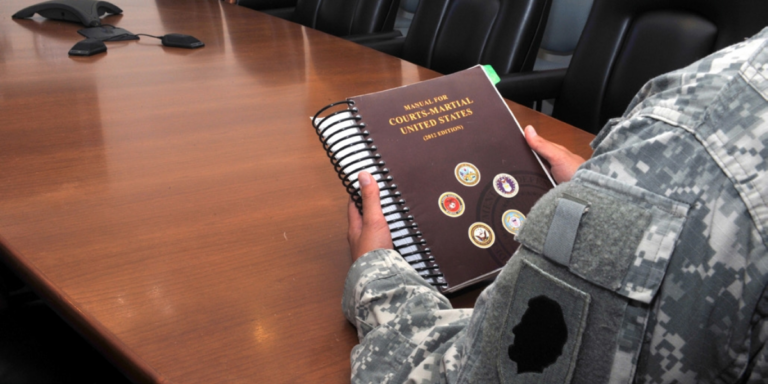
The UCMJ, enacted by Congress, establishes the substantive and procedural law governing the military justice system. Procedural rules and authorized punishments are prescribed by the President through the Manual for Courts-Martial (MCM), which is updated regularly. The court-martial process parallels a civilian criminal trial in basic structure but operates under distinct rules and command structures particular to the armed forces.
Types of Courts-Martial
The UCMJ establishes three levels of courts-martial, each corresponding to a different range of offenses and maximum penalties.
Summary court-martial
A summary court-martial addresses minor offenses and is presided over by a single commissioned officer serving in place of both judge and panel. Only enlisted members may be tried at this level. Maximum punishment is limited to 30 days confinement, forfeiture of pay, and/or reduction in rank.
Special court-martial
A special court-martial handles intermediate-level offenses and may be presided over by a military judge alone or by a judge and at least three court members. Maximum punishment includes up to 12 months confinement, forfeiture of pay, reduction in rank, and a bad-conduct discharge. A guilty verdict at this level constitutes a federal criminal conviction.
General court-martial
The general court-martial is the highest level of military trial court, reserved for the most serious offenses. It requires a military judge and no fewer than five court members, unless the accused elects trial by judge alone. The full range of authorized punishment is available, including dishonorable discharge, total forfeiture of pay, and for certain severe offenses, life imprisonment or the death penalty. A general court-martial conviction is a federal criminal conviction with consequences that extend well beyond military service.
Step 1: Investigation and Initial Charges
Command Investigation
The court-martial process begins with an investigation initiated by command or conducted by a military criminal investigative organization. Each service branch maintains its own investigative agency: the Army’s Criminal Investigation Division (CID), the Air Force Office of Special Investigations (OSI), the Naval Criminal Investigative Service (NCIS) for the Navy and Marine Corps, and the Coast Guard Investigative Service (CGIS).
In matters involving less serious or military-specific offenses, the immediate commander may conduct a preliminary inquiry directly. Throughout the investigative phase, judge advocates are available to advise commanders on disposition and legal sufficiency.
Preferral of Charges
Once an investigation concludes, the commander reviews the findings and consults with the servicing judge advocate before determining whether to act. Preferral (the formal filing of written charges under the UCMJ) occurs when the commander concludes there is probable cause to believe the accused service member committed the alleged offense. The preferred charge sheet identifies the applicable punitive articles and specifications. From this point forward, the case has entered the formal military justice process.
You can contact us 24 hours a day, 7 days a week via phone at 8885294543, by e-mail at info@tullylegal.com or by clicking the button below:
Step 2: The Article 32 Preliminary Hearing
What Happens at an Article 32 Hearing
Before any case may be referred to a general court-martial, an Article 32 preliminary hearing is required unless waived by the accused. A Preliminary Hearing Officer (PHO), typically a judge advocate, reviews the evidence to determine whether probable cause exists and whether charges are in proper form. The PHO’s recommendations are submitted to the convening authority but are not binding. Unlike a civilian grand jury, the Article 32 hearing permits active defense participation.
Rights of the Accused
At the Article 32 stage, the accused service member retains significant procedural rights, specifically those to:
Be represented by counsel
The accused has the right to military defense counsel at no cost and may also retain civilian defense counsel.
Present evidence
The defense may introduce evidence and challenge the sufficiency of the government’s case, potentially affecting whether charges are referred, reduced, or resolved at a lower forum.
Cross-examine witnesses
Defense counsel may cross-examine witnesses at the hearing, creating an early record that may bear on credibility at trial.
Step 3: Referral to Court-Martial and Trial Preparation
Role of the Convening Authority
Following the Article 32 hearing, the convening authority (typically a commanding officer with appropriate jurisdiction, or the Office of Special Trial Counsel for certain covered offenses) determines whether to refer the charges to trial, along with the level at which the case will be tried and what charges will be included. Referral completes the charge sheet and schedules the case for trial. The convening authority also conducts an initial review of any conviction and sentence prior to appellate proceedings.
Pre-Trial Motions and Discovery
Once charges are referred, both sides may file pre-trial motions on issues including suppression of unlawfully obtained evidence, dismissal for procedural violations, and unlawful command influence. The defense is entitled to discovery prior to trial, and rulings on pre-trial motions can substantially affect the proceedings.
Step 4: The Court-Martial Trial
Court Composition
At the special and general court-martial level, the accused may elect to be tried by a military judge alone or by a panel of court members. Panel members must outrank the accused. An enlisted accused may request that at least one-third of the panel consist of enlisted members. The forum election is made prior to trial, on the record, after consultation with defense counsel.
Trial Procedure
The trial begins with arraignment and proceeds through opening statements, presentation of evidence and witnesses, cross-examination, defense case, and closing arguments. The Military Rules of Evidence (found in Part III of the MCM) apply throughout, which is patterned after the Federal Rules of Evidence, and the burden of proof is beyond a reasonable doubt. In a panel trial, conviction requires the concurrence of at least three-fourths of the members present under Article 52 of the UCMJ. In a judge-alone trial, the military judge determines findings.
Ready to book your consultation? Click below to pay our consultation fee and book your meeting with an attorney today!
Step 5: Sentencing and Appeals
Sentencing Phase
If the accused is found guilty of any charge or specification, the proceedings move immediately into a sentencing phase. Unlike most civilian courts, there is generally no delay between verdict and sentencing in the military justice system. Both sides may present evidence in aggravation or mitigation, call witnesses, and make arguments. The sentencing authority (the military judge or the panel, depending on forum) deliberates and announces the sentence.
Authorized punishments vary by court-martial level and can include confinement, reduction in rank for enlisted members, forfeiture of pay, hard labor without confinement, a bad-conduct discharge, or a dishonorable discharge.
Appeals and Review
An accused convicted by court-martial is entitled to appellate review. The convening authority conducts an initial review and may approve, mitigate, or modify a legal sentence, though severity may not be increased. If the approved sentence includes a punitive discharge or confinement exceeding one year, the record proceeds to the service branch Court of Criminal Appeals, which reviews legal correctness and sentence appropriateness.
Cases may then be petitioned to the Court of Appeals for the Armed Forces (CAAF), a civilian court of five presidentially appointed judges that reviews questions of law only. In rare circumstances, a petition for certiorari to the United States Supreme Court is available.
Understanding the Military Justice Process
The court-martial process is a federal criminal proceeding with significant consequences at every stage. A service member facing a court-martial risks confinement or discharge, but also the long-term impact of a federal conviction on employment, security clearance eligibility, pension, and veterans’ benefits. The procedural rights available under the military justice system are best exercised with experienced defense representation that is engaged early on in the process.
The law firm of Tully Rinckey represents service members across all branches of the armed forces in courts-martial and related military justice matters. To discuss a potential case, please call 8885294543 to schedule a consultation, or schedule a consultation online.
Heather Tenney, Esq., LL.M. is a Partner in Tully Rinckey PLLC’s military law, federal employment, and national security law practice groups. She currently serves as the primary attorney for consultation in these areas. Heather brought her skills as an advocate and negotiator to Tully Rinckey after honorably serving with the US Army’s JAG Corps, and the results speak for themselves. At the firm, she focuses on military law; federal employment, EEO and discrimination litigation; disciplinary investigation and MSPB litigation, disability retirement, and national security clearance representation. Heather’s representation in national security and security clearance cases range from high-level military officers to covert operation officers of the CIA, NRO, FBI, DIA and a range of other intelligence agencies. Heather currently serves as Treasurer for the National Security Lawyers Association (NSLA).