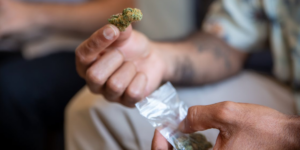
Just because a product can be bought from your local gas station—without even showing ID—does not mean its use is permitted for service members. Distributors of gas station drugs like 7-OH, Delta-8, and Tianeptine are very good at evading FDA and DEA oversight. These substances may be on more than just the DoD prohibited list. A product on the gas station shelf may even contain a Schedule I controlled substance.
Past DoD warnings framed kratom use as a violation punishable under Article 92 of the Uniform Code of Military Justice (UCMJ): Failure to Obey a Lawful Order or Regulation. Because of emergency scheduling, some kratom products now qualify for more severe punishment under Article 112a: Wrongful Use, Possession, Etc., of Controlled Substances.
DoD Policy on Kratom
Regardless of what civilian law permits, both kratom (Mitragyna speciosa) and its derivatives (mitragynine and 7-OH) are prohibited substances under DoD policy. Service members who use or possess kratom are subject to administrative action and/or discipline under the UCMJ, Article 92: Failure to obey order or regulation. Punishment under Article 92 may include:
- Loss of pay and allowances
- Two years’ confinement
- Dishonorable discharge
September of 2025, the DoD issued a memorandum banning kratom for service members (effective December 31, 2025). The memo warned that kratom is unsafe, addictive, and widely available. It’s the wide availability that’s made keeping service members informed so challenging.
The Army issued Army Directive 2016-14: Prohibition of Kratom Use this June, but the Army’s been warning Soldiers against kratom use since 2025. Back in August 2025, the Air Force reminded service members that kratom is on the Operation Supplement Safety list of DoD prohibited substances. Then in January 2026, the Navy issued an ALNAV, warning of kratom’s health risks and prohibiting use for Sailors and Marines. The Coast Guard issued a bulletin prohibiting kratom use in May 2026.
Kratom continues to be a problem, however. Now that the regulatory landscape is changing once again, kratom poses an even higher risk to service members’ health, safety, and careers.
Changing Legal Status of Kratom, Mitragynine, 7-OH, MGM-15, MGM-16
By using the emergency scheduling process, the DEA has temporarily placed select kratom-related substances in Schedule I. Emergency scheduling is temporary but can last up to three years without having to go through the more in-depth administrative process.
The Controlled Substances Act (CSA) is the framework for federally controlled substances. Substances are placed in a category: Schedule I through Schedule V. Schedule I is the most strictly controlled: the most dangerous substances with a high potential for abuse and no currently accepted medical use. Possessing or distributing Schedule I substances likewise comes with the highest consequences. Heroin is Schedule I. For perspective, cocaine is Schedule II.
The August 2026 emergency scheduling is directed at select kratom-related compounds that are synthesized from naturally occurring chemicals in the kratom plant, but affect the body like an opioid. Some of these readily available designer drugs are far stronger than morphine.
The following synthetic opioids derived from the kratom alkaloid 7-OH are now Schedule I controlled substances:
- Mitragynine pseudoindoxyl
- MGM-15
- MGM-16
Wrongful use or possession of these kratom-derived products is not only an Article 92 violation, but an Article 112a violation. Punishment under Article 112a may include:
- Loss of pay and allowances
- Dishonorable discharge
- As much as 15 years’ confinement
Ready to book your consultation? Click below to pay our consultation fee and book your meeting with an attorney today!
Kratom and Career Consequences for Service Members
Possession, manufacture, and distribution of a Schedule I substance is a serious felony drug offense (21 USC §844) that can result in fines and prison time. Just consuming a Schedule I substance may not be a crime for most civilians under the Controlled Substances Act (CSA). But for service members, wrongfully using a controlled substance is a federal crime under the UCMJ, Article 112a.
The consequences a service member may face for kratom use can change significantly depending on the specific chemical makeup of the substance in question. Some varieties of kratom are a DoD-prohibited substance, while select kratom derivatives and synthetics are also a federally illegal, Schedule I substance.
Article 92, UCMJ. Failure to Obey a Lawful Order or Regulation (10 U.S.C. § 892)
Article 92 applies to substances that are not scheduled under the CSA, but are on the DoD prohibited substances list. Service members are forbidden from using kratom, mitragynine, 7-OH, and derivatives/synthetics thereof under DoD policy.
By knowingly using kratom, service members are failing to follow DoD regulations and may be subject to discipline under Article 92, UCMJ. Whether or not kratom is legal under civilian law is immaterial. The issue is not breaking the law; the issue is failing to obey the regulation. For service members, failing to obey a lawful order or regulation is a violation of law.
Using a product may violate Article 92, UCMJ if it contains any of the following:
- Kratom
- Kratom derivatives
- Kratom synthetics
- Mitragynine
- 7-OH
- MGM-15
- MGM-16
Article 112a, UCMJ. Wrongful Use, Possession, Etc., of Controlled Substances (10 U.S.C. § 912a)
Article 112a makes it a criminal act for service members to do any of the following with a controlled substance, which now includes Schedule I kratom derivatives/synthetics:
- Wrongfully use
- Possess
- Manufacture
- Share
- Distribute
- Bring onto a military installation
- Bring into a military vehicle
Using a product may violate Article 112a, UCMJ if it contains any of the following:
- Mitragynine pseudoindoxyl
- MGM-15
- MGM-16
Potential Punishment for Drug Violations Involving Kratom
Both Article 92 and Article 112a can result in a dishonorable discharge and forfeiture of all pay and allowances. But Article 112a has the potential for significantly steeper confinement penalties: as much as 15 years, versus two years for Article 92 violations.
Note: If a service member uses MGM-15, they are violating both Article 92 and Article 112a.
What Service Members Should Know Before Using Kratom
Lack of Regulation and Unreliable Labelling
Gas station drugs are not FDA regulated. Their labels may not accurately reflect the actual contents. Highly significant and dangerous inconsistencies have been found in these products. It is possible a product lists “kratom” when it actually contains the federally illegal Schedule I substance MGM-15.
Drug Testing
Kratom may not have shown up on a routine DoD drug test in the past, but that could always change—especially now that select kratom compounds are a Schedule I substance.
Gray market/gas station drugs may result in a positive urinalysis—possibly for a substance you didn’t realize was in the product.
Don’t Count on the Ignorance Defense
Article 92 punishment applies to those who knowingly used kratom. If a Service Member was truly unaware, they may not face liability. Do not count on this defense, however. Your lack of knowledge must have truly been reasonable, and you have to be able to prove it. Speak with an attorney experienced with military matters before talking to command.
You can contact us 24 hours a day, 7 days a week via phone at 8885294543, by e-mail at info@tullylegal.com or by clicking the button below:
Do Not Risk Your Career and Your Safety
Service members should always check the Operation Supplement Safety website for the status of any substance or ingredient. But also realize that products the FDA does not regulate—like kratom—may have mislabeled ingredients. The smart option is avoiding these sketchy products all together.
The military law attorneys at Tully Rinckey PLLC served long before they became lawyers. They know the military, they know the law, and they are ready to fight hard on your behalf. If you have additional questions, our team of dedicated military law attorneys is available to assist you today. Please call (888) 356-6365 to schedule a consultation, or schedule a consultation online.
As Managing Partner of Tully Rinckey PLLC’s Houston office, Sean oversees all of the office’s operations while concentrating his practice on military law; routinely handling cases involving Article 15s, letters of reprimand, courts-martial and officer/enlisted separation proceedings. Sean also handles federal labor and employment law cases and security clearance representation. He is also a member of the National Security Lawyers Association (NSLA). He can be reached at 8885294543 or at info@tullylegal.com.