As generative AI (GenAI) usage becomes more commonplace among college students, so do allegations of AI-based academic integrity violations. Plenty of students admit to using AI tools like Grammarly to rework awkward sentences in their papers. Fewer admit to using tools like ChatGPT to draft entire portions of essays.
But not every student accused of using AI to cheat has actually done so. Such allegations of academic dishonesty can come with major consequences: baseless or not. Unfortunately, those accusing students of academic integrity violations involving GenAI are not always aware of just how tenuous the basis of such allegations can be. AI is not a reliable means of catching AI.
Why Are College Students Accused of Using AI to Cheat?
Concerned by the proliferation of GenAI-use among students, many educators have turned to AI to solve the problem of AI. The same companies that provide the GenAI some students use to cheat also market their GenAI detectors: programs that claim to identify material produced by GenAI. A confidence score indicates how likely content is to be AI-generated or human-written.
Such tools give educators an impression of confidence and reliability that the tool simply cannot guarantee. Those same companies may offer another tool that claims to remove any trace of AI-produced content. So, even those students who actually are using AI to do their work may not be flagged. These false negatives are a problem. The false positives can be devastating for students accused of cheating with AI.
Like other large language model (LLM) data-trained AI tools, AI detectors are probability-based predictive models. When presented with several words, AI determines the words most likely to follow based on the examples used to train it. If an essay’s words tend to follow a predictable pattern, that is a red flag for AI detectors. Also like GenAI, AI-detection tools operate in a “black box.” Meaning, the logic behind AI’s results is opaque—even to its engineers. This is a due process disaster.
Read more about AI and your due process: “What to Do if You’re Falsely Accused of Using AI to Cheat in College”
AI-Detection Tools and Due Process Concerns
So-called AI detectors are incredibly weak evidence. Even the companies themselves tend to advise against using their product to justify student discipline. In any case, it should never be the sole supporting evidence in charges of academic dishonesty.
More and more schools have begun advising their faculty against AI detectors. Cornell University is one of many New York schools warning faculty not to utilize automated AI-detection tools because they are too fallible to be relied upon for something so consequential as cheating accusations. Some schools, however, have not received the memo. Even if the larger institution itself knows better, your individual instructor may not be aware of how unreliable AI detectors are.
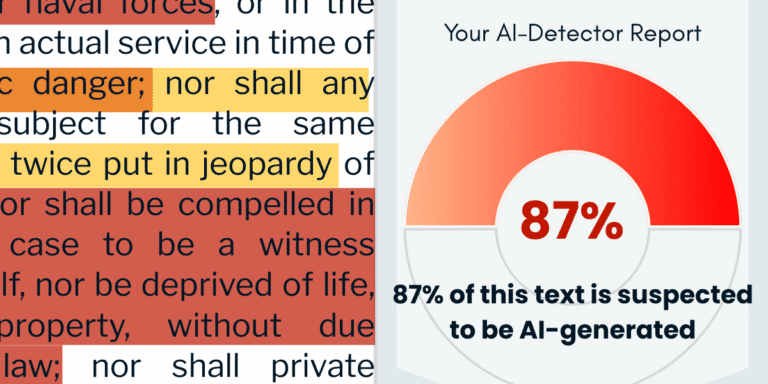
Imagine a teacher routinely runs their students’ work through an AI-detection program. They ran your essay and saw a report claiming the likelihood it was AI-generated is 87%. This report may highlight any sections calculated as likely AI-generated, but it cannot explain why. It cannot present evidence supporting its claim that you used GenAI to cheat. And yet it presents its claim—at least on the surface—as both authoritative and reliable. It is not. A deeper dive into website disclaimers may even tell you as much.
Furthermore: If the AI-detection software utilized is not officially contracted by the university, running a student’s work without consent through an unregulated LLM may constitute potential FERPA compliance issues.
Ready to book your consultation? Click below to pay our consultation fee and book your meeting with an attorney today!
Unfair Bias in AI Cheating Accusations
Certain writers are far more likely to flag a false positive in AI detectors than others. Neurodivergent students—those with autism, ADHD, dyslexia—trigger false positives more frequently than their neurotypical classmates. AI-detection tools also disproportionately flag those whose first language is not English. If you belong to either of these groups and are accused of using AI to cheat on your assignments, this is crucial information to arm yourself with.
Avoiding Accusations of Using AI to Complete Your Work
False accusations of inappropriate GenAI in schools will likely continue. For students who wish to be proactive about avoiding accusations of AI-related cheating, there are strategies available.
Review Your Syllabus and Student Handbook for Guidance on AI Use
Policies differ from school to school and classroom to classroom. Some schools have blanket policies forbidding GenAI use. Others may have an open policy and leave it to the individual departments or instructors to establish their own AI policies. In either case, carefully read both the Student Handbook and your syllabi to ensure you understand what is expected of you as a student, and what codes of conduct you agreed to follow when you enrolled.
Assess the Extent to Which You Do or Do Not Use AI Ahead of Time
AI tools are ubiquitous—often provided without users asking for them. Microsoft Word, for example, offers suggestions for changing spelling, grammar, and style by default as well as “text predictions.” These suggestions are AI-generated. Grammarly is a popular online tool that also suggests changes to wording and sentence structure in addition to spelling and grammar checks. It can be challenging to know where the line is between acceptable versus unacceptable GenAI use.
Be courteous and frank about your intended use of AI with your instructor ahead of time. Explain what you intend to use AI for and why. Perhaps you didn’t realize that such usage would qualify as cheating in the way that asking ChatGPT to write your entire essay for you would. Or, it may be that you didn’t realize the tool you planned to use qualified as AI at all.
Realize that even if a course does permit AI use, that does not mean it permits unattributed AI use. Most style guides provide rules on how to cite AI. When in doubt, consult your professor or your campus writing center beforehand.
You are still expected to Academic integrity violations cannot be evaded by claiming ignorance of student codes of conduct. But with AI, which is newer ground for everyone, there may be more room for discussion than in other cases. Such conversations would be most productive before implementing AI tools in any coursework.
Maintain a Record of Your Notes, Research, and Drafts
Maintaining process notes and revision histories of your papers—even independent of disciplinary concerns—is good practice. Most graduate students appreciate this, but many undergraduate students do not. Even if you weren’t consciously tracking your progress, you may still be able to access this information. Google Docs, for instance, allows you to view previous versions and revision history. If you did not utilize AI in a way that violates course or school policy, this could demonstrate that.
Utilizing your campus writing center is another option for developing a record of your work. Writing center staff can corroborate that any writing they assisted with is your own work. Your school’s writing center is also a good resource for asking questions about writing, responsible AI use and attribution, and academic integrity.
You can contact us 24 hours a day, 7 days a week via phone at 8885294543, by e-mail at info@tullylegal.com or by clicking the button below:
What Happens if You are Accused of Submitting AI-Produced Work?
Every school has its own policies and disciplinary process, but academic integrity violations follow a standardized format. It is crucial to study the student handbook and study this process. Often, cheating allegations follow a prescribed timeline. For example, a professor notifying a student of an academic integrity issue may trigger the time a student has to respond (e.g. 30 days), which may then trigger the timeline the investigation must follow.
You have the right to defend yourself against allegations of misconduct, including allegations of inappropriate AI use. If you are faced with potential discipline or punitive measures like a reduced grade, course failure, probation, expulsion, or delayed graduation, you have the right to challenge that. Crucially, you have the right to know the basis of the accusation. You must be allowed to see any and all evidence against you.
Learn more about finding support when accused of using AI to cheat from our article here.
Research any AI-detection tool(s) used against you, especially their fine print. Here are some things to consider when vetting tools purporting to identify GenAI:
- Landing page tends to present a far more confident picture than their disclaimer does. External reviews of a given tool’s accuracy, especially peer-reviewed research, can be extremely helpful.
- AI detection tools have a financial interest in their reliability: not only to sell the AI-detection tool itself, but to offset potential educational damage the company’s other AI assets may inflict.
Academic integrity violations are very serious. The consequences can be lifelong. That is why schools must afford students accused of wrongdoing with due process. That is also why it is well worth the cost to consult a higher education attorney as soon as you suspect an imminent academic integrity violation accusation.
Navigating the student disciplinary and appeals process while defending oneself against allegations of academic dishonesty can be overwhelming. Tully Rinckey’s higher education attorneys will handle your matter with the attention and tact it deserves. If you have additional questions about your rights as a student and due process in higher education, our team of attorneys is available to assist you today. Please call 8885294543 to schedule a consultation, or schedule a consultation online.
Greg T. Rinckey is one of Tully Rinckey PLLC’s two founding partners. He worked with Founding Partner and fellow Hofstra University alum Mathew B. Tully in 2004 to build the firm from the ground up into the coast-to-coast, full-service powerhouse that it is today. As Founding Partner, Greg collaborates with Mat in all areas of strategic planning and law practice management to develop and deploy innovative business solutions that continue to grow the firm.