When it comes to obtaining a security clearance, you absolutely must have a sponsor. A Security Clearance is not like a Driver’s License, which is issued to an individual who may then use it to drive any legally registered car. It is your Driver’s License: attached to you, not the car. Clearances, on the other hand, are not attached you, but to a billet in the Armed Forces, slot on a Federal contract, or a Full Time Equivalent (FTE) for a civilian appropriated-fund employee. It is your employment status, not you as an individual, that allows you to hold a clearance. And to be granted that employment status, you must have a sponsor: typically a Federal agency or a Federal contractor doing business with a Federal agency.
How Access Eligibility Works: The Federal Access Triangle
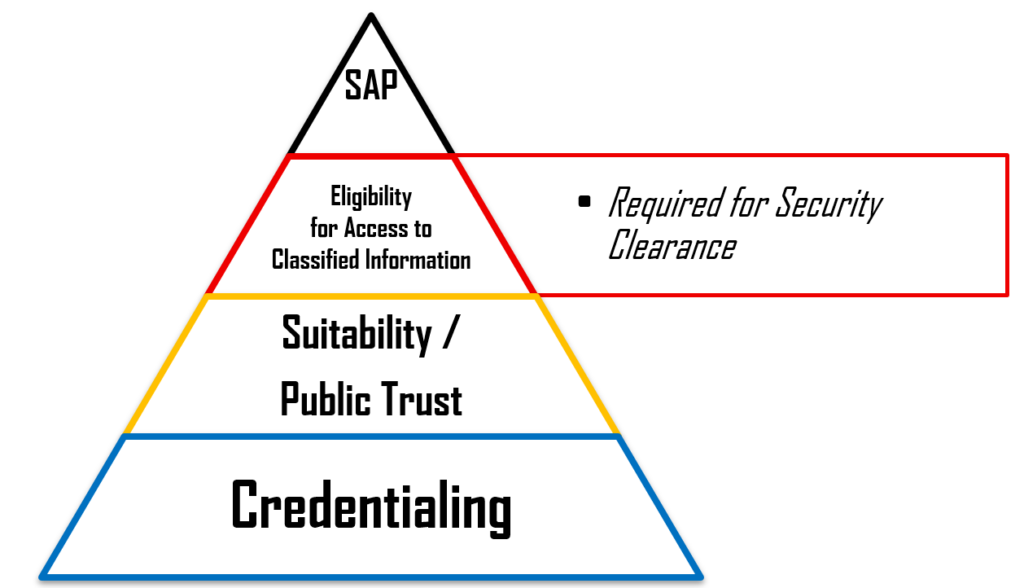
Both the seasoned clearance holder and the new clearance applicant must understand the “Federal Access Triangle” and how successive levels of review shape the human content of both the unclassified and classified workforce. Federal workers are a regulated commodity, now more than ever. The Access Triangle determines who gets in and who gets left out.
Federal Access Triangle
Picture an equilateral triangle: base at the bottom and apex at the top. Credentialing lies at the base of the Access Triangle. Everyone must have a credential to gain access to a Federal space—even visitors. Some individuals cannot get Credentialed. And so, a local Federal official (including base commanders) can use credentialling to bypass success at the next level: Suitability. Federal workers will be familiar with their PIV Card: proof they passed Credentialling.
Above Credentialing on the Access Triangle is Suitability, which is required of all Federal cadre, contractors, and service members. As of 2026, Suitability is based on nine (9) factors. Additional factors are being codified to resolve regulatory hotspots: points at which professionals have disagreed on application of the initial eight (8) factors. Suitability is also known as Public Trust.
Above both Credentialing and Suitability lies eligibility for access to classified information, which is required to be granted a Security Clearance. Public Trust certification does not grant a Security Clearance; it merely designates one as suitable for Federal employment. Security Clearances are granted based on a review of thirteen (13) Guidelines promulgated by the Director of National Intelligence (DNI) for mandatory use in all Executive branch agencies.
Special Access Programs (SAPs) form the apex of the Access Triangle.
So, to be approved for the peak of the Access Triangle, one has to be sponsored, undergo a background investigation (BI), and not trigger any security concerns under the Adjudicative Guidelines (SEAD-4). If you do trigger security concerns, you must clear the red flag on your file through successful adjudication. This can take months, if not years, to accomplish. Many Federal cadre, contractors and service members have little to no understanding of the system upon which their employment depends. The national-security-decision-making process arose from years of experience, starting long before the current generation of Federal clearance holders were born.
Continue learning about the history informing security clearance decisions from our article: The Origins of SEAD-4: Defining and Working within The Circle of Trust
How to Get Sponsored for a Security Clearance
Sponsorship is required to receive a Security Clearance. Searching for a Sponsor is not a legal process, but a business process: you need to sell yourself while interviewing for positions with both the United States Government and private corporations contracting with the same. If you do not currently hold a Security Clearance, there are still ways to land a cleared job.
Here are some tips for getting a foot in the door:
Read SEAD-4. Well before a Sponsor puts you forward for a clearance, read and live SEAD-4. And then reread SEAD-4 and SEAD-3 every year, the same week as your birthday. SEAD-4 is the code of conduct for the Federal workforce.
Look for entry-level positions. While cleared jobs require a Security clearance, other positions with the same Sponsor may be open to individuals who are willing to start in entry-level positions without a clearance and work their way into a Sponsorship.
Network with cleared professionals. Attend industry events, join professional organizations, and connect with cleared professionals on LinkedIn to build your network, and learn about job opportunities and security requirements. Do not forget the critical need for writing and posting on security issues; make yourself a security specialist.
Apply for jobs with clearance sponsorship. Some employers may be willing to sponsor an individual for clearance if they are the right fit for the job. Remember, there are many different adjudicating offices throughout the Executive branch; at least as of the summer of 2026, it is still possible to have a red flag with one agency, and a green flag with another. If you have a past clearance problem, offer to go on the books of a company, with no pay or benefits, so you can adjudicate past security concerns. This is more common in large corporations, rather than small entrepreneurial operations.
Consider a company with a government contract. Many cleared jobs are in the government or defense contractor industry, which often has a higher demand for cleared professionals.
Entering the Cleared Workspace
Remember: in all cases, working in a cleared workspace is a privilege, not a right. The Supreme Court decided that issue in 1988 (Department of the Navy v. Egan). So, approach obtaining a clearance as you would applying to a prestigious athletic program or university. Ask yourself what the employer wants, and how you provide it.
When you are unsure of your prospects for obtaining a security clearance, there are attorneys who specialize in this area. This is not a topic of discussion for your employer, agency, or Security in most cases. Their primary concerns are agency mission, company success, and national security—not your individual career. Asking the wrong person the wrong question could well paint you as more of a liability than they are willing to risk. Remember: doubts as to eligibility will err against granting you access. Your attorney is the one to bring questions to: they can provide frank and confidential guidance. Critically, this counsel comes with your goals and interests at top of mind.
Dan Meyer, Esq. is a Partner at Tully Rinckey PLLC’s Washington, D.C. office and has dedicated more than 25 years of service to the field of Federal Employment and National Security law as both a practicing attorney and federal investigator and senior executive. He is a lead in advocating for service members, Federal civilian employees, and contractors as they fight to retain their credentialing, suitability and security clearances.
Tully Rinckey attorneys understand that issues involving security clearances can be challenging, and they will handle your matter with the attention and tact it deserves. If you have additional questions, our team of dedicated security clearance attorneys is available to assist you today. Please call 8885294543, or schedule a consultation online.