If you are a federal employee, your employer has significant legal resources. Your employment is also governed by different laws than those your colleagues in the public sector face.
At Tully Rinckey, our attorneys have over 200 years of combined experience providing knowledgeable, results-driven representation for federal employees in complex employment matters.
If your rights as a federal employee have been violated, contact Tully Rinckey to consult with a federal employment attorney.
Tully Rinckey is among the largest coast-to-coast law firms focused on federal employment, military law, and security clearance representation. Our federal employment law attorneys represent clients in matters involving agency disputes, employment rights violations, and administrative claims, including but not limited to:
Equal Employment Opportunity Commission (EEOC)
Disability retirement
Disciplinary and adverse actions
Employee investigations and actions
Merit Systems Protection Board (MSPB)
Hatch Act violations
Office of Special Counsel (OSC)
Disability accommodation claims
Whistleblower representation
Pregnant Workers Fairness Act claims
Employee discrimination and harassment
Federal appeals
Transportation Security Administration (TSA) employee appeals for adverse actions
Every claim begins with a consultation, either in person or over the phone. We schedule an hour for your consultation so you can explain your situation, discuss your concerns, and ask questions. Our guide can help you prepare for your consultation.
If you choose to move forward, we will send a retainer agreement for your review. Within 24 hours of your signature, we begin work on your claim. We provide clear communication and pursue your legal goals with determined focus.
Why Choose Tully Rinckey?
Our firm’s federal employment attorneys have earned recognition from Best Lawyers, Lawdragon, the N.Y. Daily Record Labor & Employment Power Law List, and the Elite Women of the Plaintiffs Bar.
Clients have worked with us in matters involving the MSPB, the EEOC, the OSC, and federal employment appeals. We understand the pressure that comes with a federal employment dispute, and provide strategic and compassionate guidance throughout the process.
Contact Tully Rinckey to Consult With a Government Employee Attorney
As an employee of the federal government, you need an attorney with experience in federal labor and employment laws when your workplace rights are at stake. A dispute with a federal agency can involve complex procedures and significant pressure. Whether your claim involves discrimination, harassment, or another federal employment issue, contact Tully Rinckey or call us at 8885294543 to schedule your consultation with a federal employment law attorney.
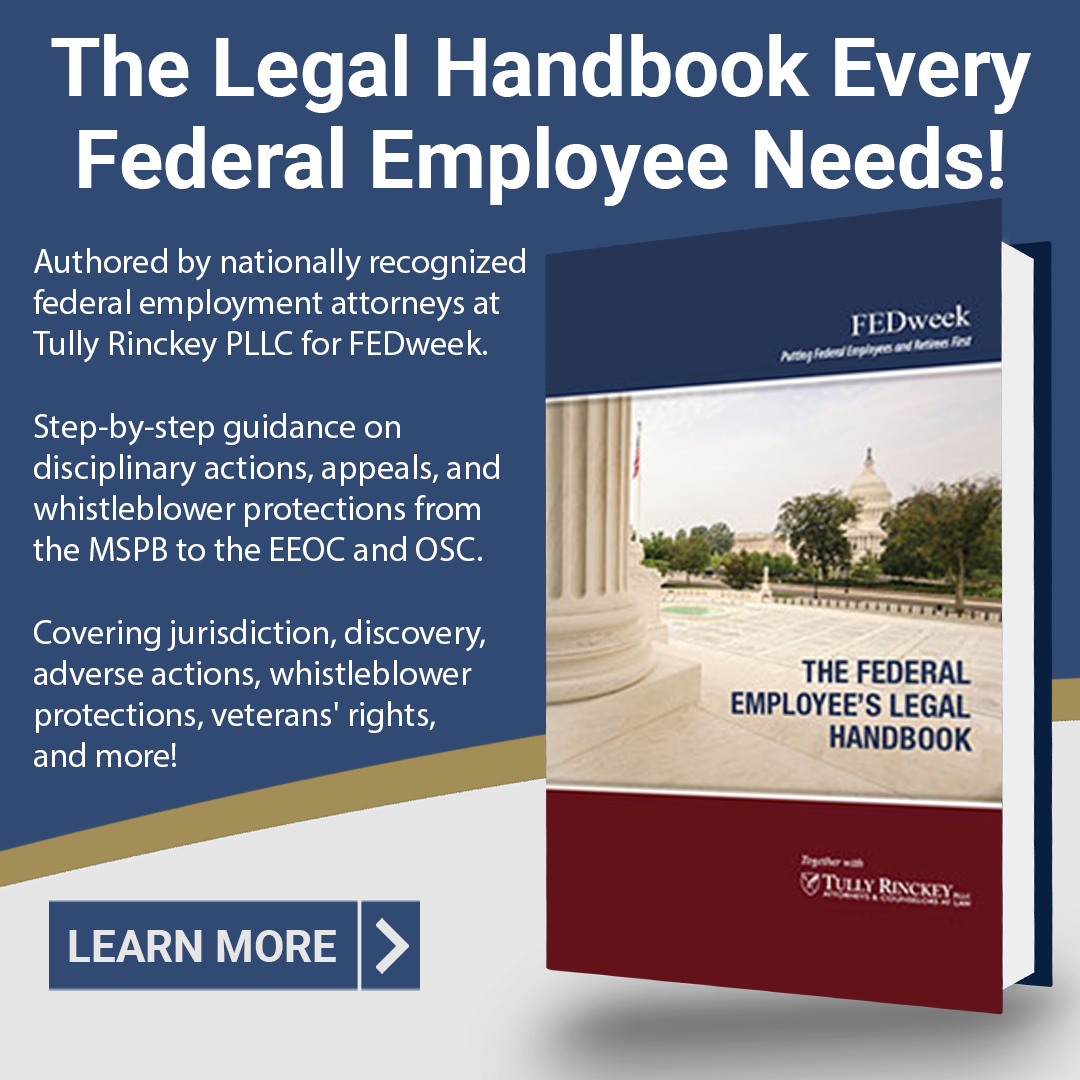
Now Available from FEDweek: The 2026 Federal Employee’s Legal Handbook
Published by FEDweek together with the federal employment attorneys at Tully Rinckey PLLC, The Federal Employee’s Legal Handbook is a plain-English guide to your rights as a federal employee — covering disciplinary and adverse actions, agency appeal processes, whistleblower protections, and the financial side of federal service, including pay, benefits, and retirement. Whether you are facing a workplace issue today or simply want to be prepared, this handbook gives you the organized overview you need.
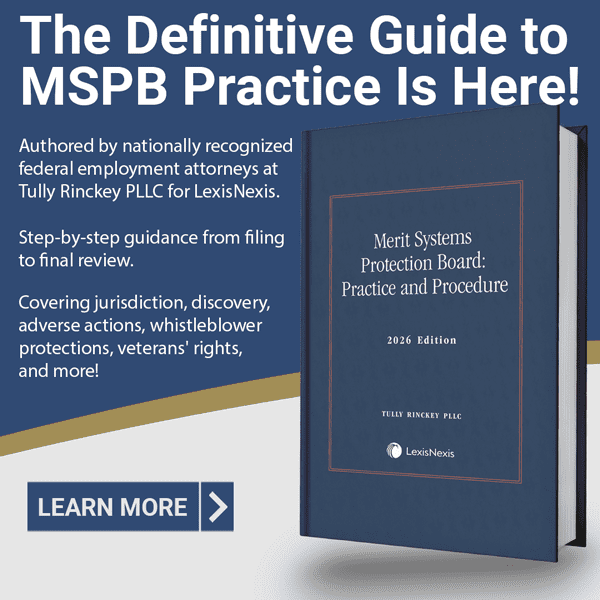
Now Available from LexisNexis: MSPB Practice and Procedure by Tully Rinckey PLLC
The seasoned federal employment attorneys at Tully Rinckey PLLC have put their extensive MSPB experience into one comprehensive resource. Merit Systems Protection Board: Practice and Procedure – 2026 Edition is a practical guide to navigating and resolving federal employment disputes before the MSPB, covering everything from filing requirements and motion practice to adverse actions under Chapters 43 and 75, whistleblower protections, Hatch Act violations, retirement appeals, and veterans’ rights claims. Whether you are facing an MSPB matter or advising someone who is, this book provides the clear, step-by-step direction you need.
Under the Civil Rights Act of 1964, all employees have the right to equal federal employment opportunities regardless of the following:
race.
color.
sex.
national origin.
religion.
age.
disability; and
prior EEO activity.
If you believe that you are a victim of unlawful discrimination based upon race, sex, national origin, religion, age, disability and/or prior equal employment opportunity activity, Tully Rinckey PLLC can help.
Our experienced attorneys can represent you at every stage of the EEO process, from filing the initial EEO complaint through settlement, trial and mediation. Call us today at 2027871900 to set up a consultation with one of our EEO attorneys or e-mail info@fedattorney.com.
Initiating a discrimination claim:
You must contact an EEO counselor at your agency within 45 calendar days of the discriminatory action. This deadline usually cannot be waived.
You may elect alternative dispute resolution (ADR) or counseling. If unsuccessful, you may then file a formal EEO complaint with your federal agency.
The agency must conduct an investigation unless your complaint is dismissed.
If your complaint contains an issue that the Merit Systems Protection Board has jurisdiction over, your case is called a “mixed case” and may proceed before the MSPB. For all other EEO matters, once the agency completes its investigation you may request an EEO hearing before a judge. The agency must complete its investigation within 180 days from the date you filed your formal complaint.
You may file in federal court at any point after the formal complaint has been pending for more than 180 days.
The attorneys at Tully Rinckey PLLC can represent you at every stage of the EEO process, including initial EEO counseling, ADR, mediation, trial, and appeal if necessary. Call us today at 2027871900 to set up a consultation with one of our EEO attorneys or e-mail info@fedattorney.com.
At Tully Rinckey PPLC, it is our belief that every federal employee has the right to due process and a fair hearing, including proper application of the Douglas Factors, the mitigating circumstances developed by the MSPB in Douglas v. Veterans Administration. Any disciplinary action can lead to greater problems in the future and, in extreme cases, can result in the end of an employee’s career in federal service.
The attorneys at Tully Rinckey PLLC have litigated hundreds of cases at the agency level, before MSPB administrative judges, as well as before the full three-member MSPB panel. If necessary, our attorneys are also experienced and have been successful in arguing appeals of MSPB decisions before the U.S. Court of Appeals for the Federal Circuit.
Contact Tully Rinckey PLLC to see how we may assist with your case. We can be reached 24 hours a day, 7 days a week, at 2027871900 or by e-mail at info@fedattorney.com.
Unfortunately, federal employees may fall victim to a medical condition which may prevent them from efficiently performing essential job functions of their position. When this occurs, federal employees may be entitled to disability retirement benefits. At Tully Rinckey PLLC, we assist federal employees with the complex process of applying and securing disability retirement benefits. Our firm can handle all aspects of the disability retirement application process, including assisting you in preparing your application, working with your physician to obtain the proper medical documentation, requesting reconsideration of an OPM determination, or appealing an adverse OPM determination to the Merit Systems Protection Board.
Eligibility Requirements for Disability Retirement
To qualify for disability retirement benefits, a federal employee must meet the following requirements:
completion of five years of credible federal civilian service under CSRS or 18 months of federal civilian service under FERS;
have a disability due to disease, injury or mental health condition which prohibits you from performing useful and efficient service in your current position;
disability must be expected to last at least one year; and
agency must certify that it is unable to accommodate your disabling medical condition in your present position and that it has considered you for any vacant position in the same agency at the same grade or pay level and within the same commuting area, or for which you are qualified for reassignment
When a federal employee is issued a proposed or actual disciplinary or adverse action, nothing is more important than understanding your rights and fighting to protect them.
Tully Rinckey’s team of experienced federal employment attorneys are available to provide representation to federal employees who are under investigation or facing proposed disciplinary or adverse actions. In the federal government, a disciplinary action includes suspensions of 14 days or less and reprimands, while “adverse actions” include the more severe forms of discipline including removals, suspensions of more than 14 days, and/or a reduction in grade or pay or demotion.
When a federal employee is issued a proposed or actual disciplinary or adverse action, nothing is more important than understanding your rights and fighting to protect them.
Tully Rinckey’s experienced federal employment attorneys are available to provide representation to federal employees who are under investigation for misconduct, facing proposed disciplinary or adverse actions for misconduct or poor performance, or appealing or otherwise challenging disciplinary or adverse actions. In the federal government, a disciplinary action includes suspensions of 14 days or less and reprimands, while an adverse action includes the more severe forms of discipline such as, removals, suspensions of more than 14 days, and a reduction in grade (demotion) or pay.
Tully Rinckey lawyers have experience defending the interests of federal employees who are charged with a wide range of alleged misconduct, including, but not limited to:
Absence without leave (AWOL) or other attendance issues
Misuse of funds
Violence in the workplace
Falsification
Insubordination or failure to follow directives
Security violations
Improper use or theft of government property
Conduct unbecoming a federal employee
Prohibited personnel practices
Lack of candor
Additionally, Tully Rinckey lawyers are available to assist federal employees who are faced with allegations of poor performance, have been placed on a Performance Improvement Plan (PIP) and/or are issued performance related discipline, such as a proposed removal or demotion. Tully Rinckey attorneys are also available to represent federal employees who have received a performance-related adverse action that needs to be appealed to the Merit System Protection Board.
At every stage of the investigatory or disciplinary process, Tully Rinckey attorneys will work with you and your agency to find the best solution possible for your career. Learn more
Employee Discrimination and Harassment
Under the Civil Rights Act of 1964 (Title VII), and other Federal statutes, including the Americans with Disabilities Act (ADA) and the Age Discrimination in Employment Act (ADEA), employment decisions, including hiring, promotion and termination, cannot be based on race, color, sex, national origin, religion, age, disability or prior EEO activity.
In addition, it is unlawful to subject an employee to harassment/hostile work environment or disparate treatment based on his/her membership in any of those protected classes.
Tully Rinckey attorneys have extensive experience representing both private and public sector clients who have been subjected to or are accused of unlawful employment discrimination. Our attorneys have represented clients nationwide in the following type of employment discrimination matters:
Discrimination claims based on race, color, sex, pregnancy, age, national origin, religion, disability, marital status, political affiliation, veterans preference, uniform service, or other protected categories, including those listed above
Sexual harassment and other harassment
Discrimination based on retaliation for participation in prior EEO activities
Denial of equal pay for equal work
If you believe that you are a victim of unlawful discrimination, you should call one of our experienced attorneys who practices before the EEOC. Our attorneys can represent you at every stage of the EEO process from pre-complaint counseling, formal EEO complaint, alternative dispute resolution, settlement and hearing all the way through to final appeal.
Initiating an EEO Claim
As with most aspects of the federal employment system, the deadlines surrounding the EEO complaint process for federal employees are tight and unforgiving. Discrimination complaints must normally be filed with the agency’s EEO office for counseling within 45 calendar days of the discriminatory action. The counseling process generally must be completed within 30-90 days of filing. At that point, if the matter has not been resolved, the employee must be given notice of the right to file a formal complaint, after which s/he has only 15 calendar days to file the formal complaint.
After a formal complaint is filed, the agency will decide whether to dismiss the complaint or conduct a formal investigation into the allegation of discrimination. These investigations, which are typically performed by outside contractors under the direction of the Agency’s EEO office, generally must be completed within 180 days after the date of filing of the complaint. The investigator will file a Report of Investigation (ROI) with the agency, which will provide a copy to the employee.
At that point, the employee has 30 calendar days to request either a Final Agency Decision (FAD) or a formal hearing at the EEOC. If the employee does not elect an EEOC hearing within 30 days, the Agency will issue a final agency decision. If the employee does not receive the ROI within 180 days after the complaint was filed, s/he may request a hearing from the EEOC. These deadlines cannot be extended.
Contact Us
Tully Rinckey PLLC can represent clients at all stages of the federal EEO process, from initial EEO counselor contact, to mediation, and through appeals in federal court.
If you are a federal employee facing or accused of discrimination, contact us to see how our experienced employment discrimination attorneys may assist you.
We can be reached 24 hours a day, 7 days a week at 2027871900 or via email at info@fedattorney.com.
Federal Appeals
Adverse federal employment decisions typically are subject to review by appeal. At Tully Rinckey, our attorneys are experienced and available to represent you at any stage of litigation, including the appeal of a negative decision by an Administrative Judge, the Merit Systems Protection Board, OPM, OSC, or even a federal court judge.
Tully Rinckey has had great success on appeals taken to the full Merit Systems Protection Board and the United States Court of Appeals for the Federal Circuit. Our attorneys’ major appellate wins include:
Federal Circuit Decisions
Pucilowski v. Department of Justice, 498 F.3d 1341 (Fed. Cir.2007).
Hernandez v. Department of the Air Force, 498 F.3d 1328 (Fed. Cir. 2007).
VanWersch v. Department of Health and Human Services, 197 F.3d 1144 (Fed. Cir. 1999).
Merit Systems Protection Board Decisions
Haskins v. Department of the Navy, 2007 M.S.P.R. 234 (2007).
Plezia v. Department of Veterans Affairs, 2006 M.S.P.R. 135 (2006).
Pratt v. Department of Transportation, 2006 M.S.P.R. 244 (2006).
Farrell v. Secretary, Dep’t of Treasury, EEOC Petition No. 0420070019 (Oct. 24, 2008)
Farrell v. Secretary, Dep’t of Treasury, EEOC Appeal No. 07A20043 (May 3, 2003)
Flythe v. Caldera, Secretary, Department of the Army, EEOC No. 01972258 (2000)
The appeals process is subject to very strict and unforgiving timelines. If you miss a deadline, your appeal rights could be lost.
If an agency has ruled against you and you would like to initiate the appeal process or find out more about your appeal rights, contact our office to see how our experienced federal appeals attorneys may assist you.
Our Lawyers are available to review your case and discuss with you the merits of a possible appeal.
Tully Rinckey can be reached 24 hours a day, 7 days a week at 2027871900 or via email at info@fedattorney.com.
Hatch Act Violations
Politics & Work: A Dangerous Combination
Most federal employees care deeply about the well-being of the government they serve. As such, many involve themselves in partisan elections to support certain candidates to lead the government. While participation in elections is important to democracy, federal employees in the executive branch and employees of the D.C. government need to be especially careful about how they participate in political campaigns. Under the Hatch Act (5 U.S.C. § 7321-7326), a federal employee’s career could be put at risk if they engage in any prohibited political activities.
It is not uncommon for federal employees to get as passionate about political elections as they are about their work. Amid all the excitement, a federal employee’s slip in good judgment could result in an egregious Hatch Act violation. By forwarding an e-mail that includes a solicitation for funds for a partisan campaign or by encouraging co-workers to attend a political fundraiser, federal employees could end up facing removal or suspension.
Hatch Act Investigations & Enforcement
The Office of Special Counsel (OSC) is responsible for investigating Hatch Act violations and enforcing the law. OSC brings enforcement cases under the Hatch Act to the Merit Systems Protection Board (MSPB) and issues advisory opinions for employees who are uncertain whether their activities fall under the law’s coverage
Tully Rinckey PLLC’s Hatch Act attorneys in Washington, D.C. can aggressively represent federal employees before the Merit Systems Protection Board (MSPB) against adverse actions sought by the OSC. It is crucial that federal employers who may be questioned about potential prohibited political activities are aware of their rights and should immediately contact a federal employment lawyer upon learning they are under investigation for suspicion of a Hatch Act violation.
Tully Rinckey PLLC’s Hatch Act attorneys in Washington, D.C. can defend federal employees’ rights during OSC investigations and MSPB proceedings. To schedule a meeting with one of Tully Rinckey PLLC’s Hatch Act attorneys, call (202) 851-0729 or e-mail info@fedattorney.com.
Prohibited Political Activities
Prohibited activities in political campaigns or management for most executive branch employees generally include:
affecting or influencing election results through the use of their official authority or influence;
knowingly receiving, accepting or soliciting political contributions, with some exceptions;
running for office in a partisan election; and
knowingly asking others to participate in political activities or discouraging them to do so.
Executive branch employees should generally refrain from engaging in political activities:
while on duty;
in any federal government office or building;
while in uniform or wearing official insignia; and
while using any federal government-owned or leased vehicle.
Hatch Act Violation Penalties
The Hatch Act is a very heavy-handed law. It calls for the removal of federal employees who engage in the above-noted prohibited political activities. The MSPB, however, can grant a more lenient penalty of at least 30 days suspension without pay if the board unanimously decides removal is too severe.
Tully Rinckey PLLC’s Hatch Act attorneys in Washington, D.C. can help federal employees to dismiss OSC charges or to reduce the penalties associated with such charges. To schedule a meeting with one of Tully Rinckey PLLC’s Hatch Act attorneys, call 2027871900 or e-mail info@fedattorney.com.
Pregnant Workers Fairness Act
Under the 2023 Pregnant Workers Fairness Act (PWFA), employers and labor organizations are required to offer reasonable accommodations for qualifying employees with limitations due to childbirth and pregnancy. The PWFA applies to private employers and public sector employers (state and local governments) that have 15 or more employees. It also applies to Congress and Federal agencies, and to employment agencies and labor organizations.
While the PWFA only applies to accommodations, many states already have laws protecting and providing access accommodations for pregnant workers.
Additionally, On April 15, 2024, the EEOC issued its final regulation to carry out the law. The final regulation went into effect on June 18, 2024. On June 27, 2023, the EEOC began accepting charges alleging violations of the PWFA.
In some situations, workers affected by pregnancy, childbirth, or related medical conditions may also be entitled to receive an accommodation under two other laws the EEOC enforces, Title VII of the Civil Rights Act of 1964 or the Americans with Disabilities Act (ADA). Therefore, the EEOC will continue to accept and process charges involving a lack of accommodation regarding pregnancy, childbirth, or related medical conditions under Title VII and/or the ADA as well as under the PWFA. At Tully Rinckey, we are well versed in pregnancy discrimination law and have helped many victims of unlawful pregnancy discrimination secure the recourse they deserve. To learn more about the PWFA and how it will impact employees, please visit our subpage on the topic here.
TSA Employees: Appeals to Adverse Actions
Like other federal employees, TSA workers are subject to certain rules concerning their conduct and performance. If TSA believes that an employee has violated any of its standards, it may choose to take adverse action (e.g. a suspension of more than 15 days or termination from service) against that employee. TSA employees have the right to appeal such adverse actions. However, because TSA is not an agency captured under Title 5, its appellate procedures differ significantly from the majority of federal agencies.
Adverse Actions
While most federal employees can appeal an adverse action taken against them to the U.S. Merit Systems Protection Board (MSPB), TSA employees must appeal adverse actions to the agency’s Office of Professional Responsibility (OPR) Appellate Review Board (OAB).
TSA Management Directive No. 1100.77-1 outlines the duties and responsibilities of the OAB, formerly known as the Disciplinary Review Board. Pursuant to the TSA’s policies, the OAB will review appeals to the following adverse actions:
Suspensions of at least 15 days
Involuntary demotions for conduct/performance
Indefinite suspensions
Furloughs
Removal from service for conduct/performance
Involuntary workforce reduction removals
USERRA removals
The OAB does not review whistleblower retaliation cases. Instead, whistleblower reprisal cases can generally be appealed to the MSPB by TSA employees, if and only if that employee has exhausted their administrative remedies with the Office of Special Counsel.
TSA employees may select a representative of their choosing to assist in the preparation and presentation of their appeal to the OAB. It is critical for employees to have skilled legal representation before the OAB, because it is the ultimate and only level of appellate review available to employees who have been terminated or otherwise subjected to adverse action by TSA.
The attorneys at Tully Rinckey PLLC are experienced in assisting TSA employees with appealing adverse actions to the OAB. Call us today to schedule a meeting with one of Tully Rinckey PLLC’s lawyers at 8885294543 or e-mail info@fedattorney.com.
VEOA
As a service-disabled veteran-owned law firm, our attorneys understand the importance of your service to our country. As a result, we aggressively fight for the rights of our nation’s veterans both in and out of the workplace, including the right to preference eligibility when being considered for a position within the civil service.
When an agency accepts applications from outside its own workforce, the Veterans’ Employment Opportunities Act of 1998 (VEOA) allows preference-eligible veterans to compete for these vacancies under merit promotion procedures. VEOA applies to virtually all agencies and positions within the federal government.
This law makes an agency’s willful violation of veterans’ preference a prohibited personnel practice under law, and gives veterans who are federal employees or applicants for federal positions the right to challenge a violation of their rights.
Our attorneys, many of whom are veterans themselves and know what it means to have served, are available to assist you if you believe your rights under the VEOA have been violated.
When you choose Tully Rinckey PLLC, you aren’t just assigned an attorney. Your legal matter will be cared for by our entire legal team and support staff. With offices throughout the United States, we make sure you receive legal counsel and representation you can trust.
Commitment to Our Clients
Our team-oriented philosophy encourages open and ongoing communication with every attorney, paralegal, and other support staff working with each client ensures we understand their goals. Our commitment to you means meeting your objectives, working attentively and persistently toward your success, and efficiently adjusting to your changing needs.
Ethics and Professional Responsibility
At Tully Rinckey, we work relentlessly to ensure our ethical standards and level of professionalism surpass what is expected of us by our clients and the court. Our high ethical principles call us to treat clients with respect, offer affordability to members of the communities we serve, and provide composed and dignified representation.