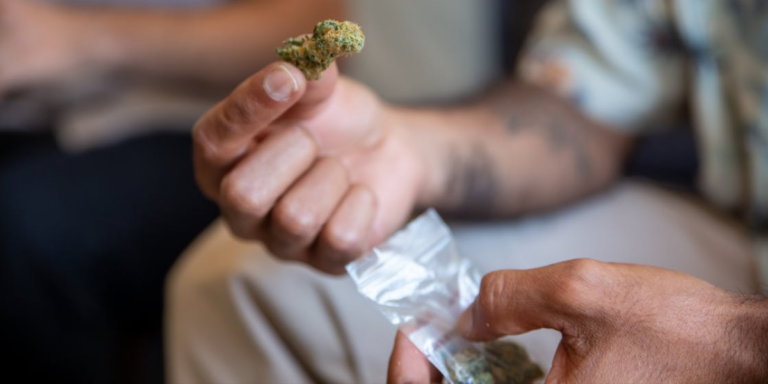
In most states, marijuana is legal in some capacity—at the state level. On December 18, 2025, President Trump’s executive order directed the Attorney General to initiate the rescheduling process; the Attorney General then issued an order on April 23, 2026 to reschedule medical marijuana. But after court challenges, the rescheduling has been stayed and must proceed through the formal rulemaking process before taking effect. At present, marijuana remains a federally illegal Schedule I substance. This means U.S. military personnel may still face severe consequences for marijuana use.
Marijuana Use and the UCMJ
Article 112a of the Uniform Code of Military Justice (UCMJ) concerns wrongful use and possession of controlled substances; it prohibits all use and possession of marijuana for U.S. military members. Violations may result in court-martial.
Cannabis is currently classified as a Schedule I drug, making both use and possession a serious offense under federal law. Should cannabis be reclassified as Schedule III, this would not automatically open the door for servicemembers—or anyone else—to access recreational or medical marijuana without legal consequence. That would require a multitude of additional policy changes across multiple federal agencies, not only the military.
UCMJ Article 112a does not apply to Schedule I drugs only. Wrongful use, possession, and distribution of drugs classified as Schedule I through Schedule V are also prohibited. Cannabis may be reclassified as a Schedule III drug. Use and possession of a Schedule III drug without a valid prescription is also illegal and punishable by court-martial.
Changing Military Attitudes Toward Past Marijuana Offenses
It remains unclear what, if any, effect rescheduling cannabis would have on military policy. However, the military has been relaxing some restrictions when it comes to past marijuana use. Although excessive use, dependency and past drug or alcohol convictions currently disqualify individuals from enlisting in the military, limited marijuana use—particularly in states where it is legal—is not necessarily an automatic disqualifier in 2026.
A March 2026 update to U.S. Army enlistment eligibility regulations further reflects changing attitudes toward marijuana. Individuals with one conviction of marijuana possession or drug paraphernalia possession are no longer required to receive a waiver in order to enlist (AR 601-210 para. 4–6).
This does not mean cannabis use is permitted after enlisting, however. That same guidance reinforces that the Army has a zero-tolerance policy toward marijuana use by servicemembers, and in-service marijuana use is a punishable offense under the UCMJ (AR 601-210 para. 6–5).
Ready to book your consultation? Click below to pay our consultation fee and book your meeting with an attorney today!
Special Considerations for Security Clearance Holders
Military personnel with security clearance risk revocation of their access eligibility if they use marijuana. Within the National Adjudicative Guidelines (SEAD-4), multiple categories of security concern may apply to cannabis, including:
- Guideline E, Personal Conduct
- Guideline H, Drug Involvement and Substance Misuse
- Guideline J, Criminal Conduct
In the event marijuana is reclassified as Schedule III, the risk for cleared personnel will remain. Guideline H, Drug Involvement and Substance Misuse security concerns do not apply solely to Schedule I drugs, but also Schedule III. Misusing a Schedule III substance—even one’s own prescription—would still trigger security concern under Guideline H.
Furthermore, federal legalization would not retroactively apply in security clearance adjudications without additional changes to adjudicative guidelines. Guideline J, Criminal Conduct and Guideline E, Personal Conduct security concerns apply to behavior that is illegal at the time the behavior took place. Failure to observe laws and rules speaks poorly of an individual’s trustworthiness and reliability: a potential cause for security clearance revocation or denial.
For security clearance adjudication purposes, it matters whether the activity violated rules or laws at the time. For both the present moment and foreseeable future, marijuana use is illegal at the federal level.
To learn more about the impact of marijuana rescheduling for security clearance holders, see our article: Schedule III Cannabis Won’t Change Much for Security Clearance Holders.
What About Medical Marijuana?
Military Servicemembers
Just as recreational marijuana is currently illegal for U.S. military personnel to use or possess, medical marijuana is also off limits. There are no exceptions for military personnel—not even with physician prescriptions or doctor-approved medical marijuana cards.
Veterans and VA Health Benefits
Under current Veterans Health Administration policy (VHA Directive 1315), veterans who seek care from the U.S. Veterans Administration (VA) will not be denied VA benefits or care because of marijuana use.
However, as cannabis is a federally illegal Schedule I substance, VA clinicians can neither recommend nor prescribe medical marijuana. This also applies to VA facilities located in states with legalized medical marijuana. VA clinicians may only prescribe medications that have been approved by the U.S. Food and Drug Administration for medical use. To date, the only FDA-approved cannabis-derived drug is treatment for a rare form of epilepsy.
The Future of Medical Marijuana for Military Members
There is considerable public support for medical cannabis research to aid veterans with diagnoses such as post-traumatic stress disorder and chronic pain. President Trump’s December 2025 executive order (EO 14370) specifically referenced veterans’ use of medical cannabis as an alternative to opioids.
Though the Medical Marijuana and Cannabidiol Research Expansion Act has been in effect since 2022, the degree to which it has facilitated medical marijuana research has been limited. Rescheduling cannabis would enable further research: one of many steps required before the VA or anyone else can write a federally legal prescription for medical marijuana.
In the meantime, military personnel who use marijuana or have failed a drug test due to marijuana face serious consequences. Seek the advice of a military attorney before making any statements or accepting non-judicial punishment.
Reviewed October 2026 to ensure contents reflect recent policy updates.
The military law attorneys at Tully Rinckey PLLC served long before they became lawyers. They know the military, they know the law, and they are ready to fight hard on your behalf. If you have additional questions, our team of dedicated military law attorneys is available to assist you today. Please call 8885294543 to schedule a consultation, or schedule a consultation online
Heather Tenney, Esq., LL.M. is a Partner in Tully Rinckey PLLC’s military law, federal employment, and national security law practice groups. She currently serves as the primary attorney for consultation in these areas. Heather brought her skills as an advocate and negotiator to Tully Rinckey after honorably serving with the US Army’s JAG Corps, and the results speak for themselves. At the firm, she focuses on military law; federal employment, EEO and discrimination litigation; disciplinary investigation and MSPB litigation, disability retirement, and national security clearance representation. Heather’s representation in national security and security clearance cases range from high-level military officers to covert operation officers of the CIA, NRO, FBI, DIA and a range of other intelligence agencies. Heather currently serves as Treasurer for the National Security Lawyers Association (NSLA).